


The impact of fleet electrification on logistics and operations
The electrification of truck fleets represents a major turning point for the transport and logistics sector. Beyond the widely recognized environmental benefits, the transition to electric can proceed without requiring a major paradigm shift, while it can also entail a significant overhaul of daily operations and logistics practices. This transformation raises legitimate questions about the ability of electric vehicles to maintain the logistical performance that companies and their customers are accustomed to. This brief examines the concrete challenges in logistics and operations and practical solutions for a successful transition to electrifying truck fleets.

Mathieu Chevigny
Analyste d'applications, Institut du véhicule innovant (IVI)

Edwin Richard
Directeur des projets spéciaux et du développement durable, Nationex

Jean-François Brossard
Directeur des technologies et innovations énergétiques, Location Brossard

Martin Casaubon
Vice-président Opérations, Les Emballages Carrousel
Route planning and meeting deadlines
Meeting delivery deadlines is a major concern for carriers considering electrification. Concrete examples show that the impact of electrification varies considerably depending on the type of operations and the territory served.
The impact of transport electrification varies greatly depending on the industry sector, the nature of the goods transported, the type of territory (urban or rural) and the distances to be covered. Some operations, notably those involving trips of a few hundred kilometers, can integrate electrification with few logistical adjustments, while others will require more extensive planning.

Mathieu Chevigny, applications analyst at the Innovative Vehicle Institute (IVI), confirms this reality: “Electric trucks can fully meet the needs of urban delivery without causing delays, provided that operations have been well planned in advance and that requirements have been clearly defined before they are put into service.”
And even for regional intercity trips, electrification should not significantly affect operations.
“For trips between cities that are not too far apart, there is no reason this should impact operations. Electric trucks today offer ranges that allow them to handle this type of intercity trip without difficulty,” adds Martin Casaubon, Vice-President of Operations at LesEmballages CarrouselInc.
Regarding delivery times, the situation varies depending on the distance traveled:

For short and medium distances (less than 250 km): electric trucks can easily meet delivery deadlines.

For long distances: it is very variable depending on how operations are run. If driver downtime, at customers or at the depot for example, is used to recharge the batteries, it is possible for an electric truck to have delivery times similar to diesel trucks. However, in cases where the driver must stop strictly to recharge, a practical rule of thumb is to allow about 25 to 35% additional time.
It should be noted that the above observations are valid for relatively light weights (10 to 20 tonnes). When vehicles must travel long distances without immediate access to a charging point, it is essential to properly plan charging en route.
Route categorization and adaptation of operations
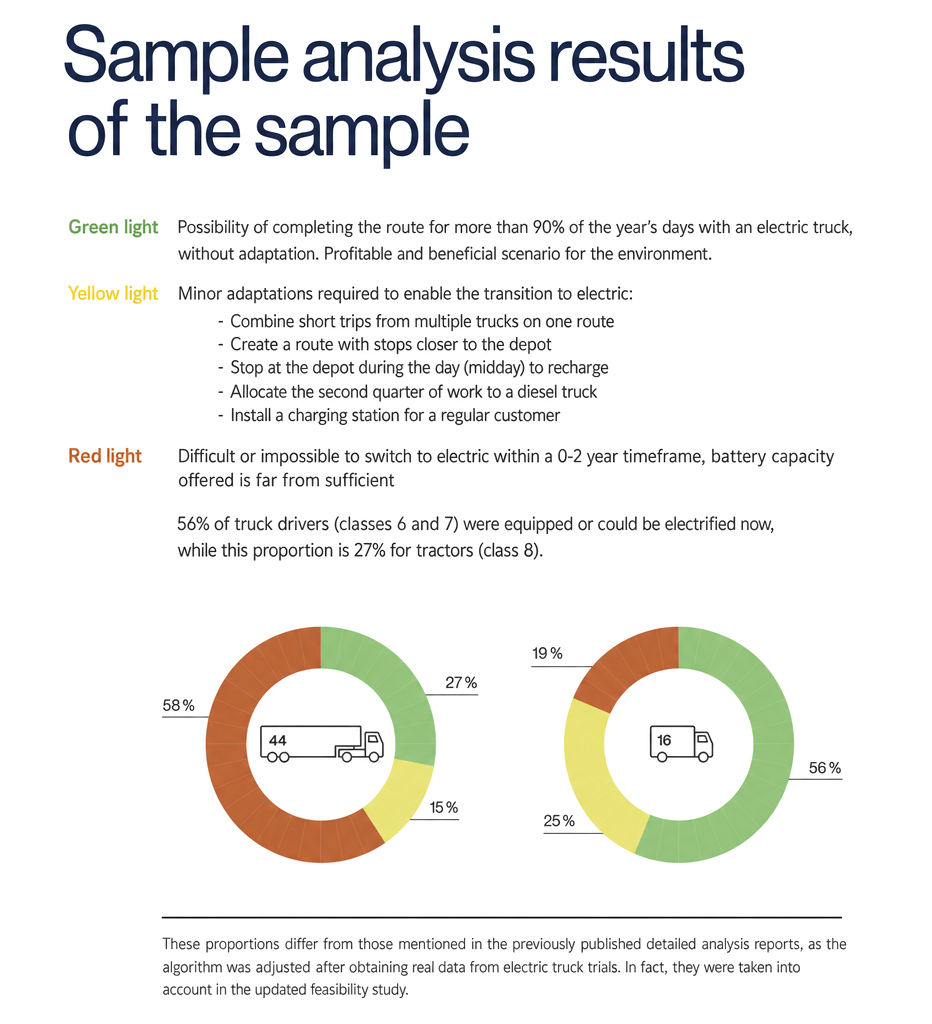
A pragmatic approach is to categorize routes to identify those that are immediately compatible with electrification. Astudy conducted by the Innovative Vehicle Institute (IVI)[1]as part of a trial project for medium and heavy electric trucks, uses a color-coded classification system:
- Green routes: routes that can be completed on 90% of days of the year with an electric truck without any adaptations.
- Yellow routes: routes with strong electrification potential but requiring adaptations.
- Red routes: routes not electrifiable in the short term (0-2 years) without major adaptations.
Green routes
In the case of green routes, electric trucks can fully meet delivery deadlines. The greater challenge arises when electrifying trucks on “yellow” routes. As an indication, in its analyses the IVI found that nearly 15% of the 44 class 8 trucks they studied used so-called “yellow” routes, as did 25% of the 16 class 6 and 7 trucks they studied. “Green” routes are obviously where it makes sense to start. Intermediate-potential routes, the “yellow” ones, represent a way to go further in electrifying the fleet once the green routes are electrified, but they also carry more risks. By concentrating efforts on these routes as well, companies can get more benefit from fleet electrification and reduce their GHG emissions further than if they limited themselves only to “green” routes.
Yellow routes
For the yellow routes studied in their project, Mathieu Chevigny of the IVI proposes several concrete operational adaptations to make as many routes as possible electrifiable:
- Creation of dedicated routes: “Among the solutions considered was grouping several short trips to create a dedicated route. Thus, some companies operating several short routes could combine them to form a single circuit of about 200 km. A 200 km radius means the route can be 400 km (round trip).”
- Midday charging: “Setting up a stop or a depot during the day can be a solution, although this does not suit all companies. Some already return at lunchtime to a depot, which opens the door to a quick recharge allowing them to resume the route in the afternoon and complete the day without constraint.”
- Fleet hybridization by shifts: “It is possible to do the first segment of the tour with an electric truck, then continue the second with a diesel vehicle once the first portion is completed.”
- Installation of chargers at regular customers' sites: “For regular shuttle trips between a main warehouse and a client’s warehouse, it may be appropriate to install a charging point at the client's site. This would allow recharging the vehicle for 30 to 60 minutes during drop-offs before resuming the route.”
For his part, Edwin Richard, Director of Special Projects and Sustainable Development atNationex, confirms this step-by-step approach:
“The approach envisaged is a ‘one-for-one’ electrification, that is, the direct replacement of an internal combustion vehicle with an electric vehicle. Upstream, this involves assessing the trips that can be electrified under this model. Once phase 1 is completed and partner buy-in is confirmed, phase 2 can begin: a new stage focused on optimizing and fine-tuning practices.”
Impact on schedules and planning
Regarding adapting schedules to accommodate charging times, Mathieu Chevigny of the Innovative Vehicle Institute (IVI) notes: “Do schedules need to be adapted? It depends. In some cases studied, it is not necessary. For example, for fleets operating on a single shift whose trucks return to the depot at night, charging can be done overnight without impacting operations.”
The data collected by the IVI during theirproject are revealing:

“There was plenty of time to fully recharge the trucks without having to modify operations,” says Mathieu Chevigny. He adds, however, that “you still have to make sure the truck is properly parked and plugged in correctly during the night.”
Specific operational changes are often necessary, such as:
- Changing departure times with optimized settings;
- Implementing vehicle preconditioning* to gain range;
- Managing cabin heating differently.
* Preconditioning an electric truck means heating or cooling the cabin and the battery before departure, while the vehicle is still plugged into a charging station.
Kevin Lambert, Director of Equipment and Warranties at Groupe Robert, recently shared his experience on this topic as part of a panel discussion at ExpoCam:
“Electrifying our fleet had a more marked impact at the start, but it is now better controlled. To limit unforeseen events, trucks run on dedicated routes. We also adjusted break times so they align with our opportunity-charging strategy. Thanks to these adjustments and other complementary actions, we were able to meet the initial challenges and successfully integrate electric trucks into our operations.”
Perception and the gap between theory and practice
Early experiences with truck electrification reveal a notable gap between carriers' perceptions and the true potential of the electric shift. Many routes are already compatible with electrification, often much more than is generally believed.**
The analysis of real-world data generally reveals an electrification potential well above initial estimates, including for the fleets involved in the IVI project. As Mathieu Chevigny of the Innovative Vehicle Institute (IVI) recommends:
“The ideal is to start by electrifying the trucks that can be done without changing anything. You should proceed in stages, prioritizing vehicles with the simplest routes, rather than trying to electrify the entire fleet at once.”
** From an operational standpoint, truck electrification is much more realistic than it may seem at first for many trucks. Data on truck trips show that the majority of medium-weight trucks (81%) travel less than 240 km per day in North America. As for heavy trucks, 53% travel less than 320 km per day on average. These trips are perfectly compatible with the range of electric trucks, which can vary between 200 and 300 km.[2]
Understanding limitations to better achieve a successful transition
The electrification of truck fleets paves the way for more sustainable logistics. However, to fully benefit from it, it is essential to understand the technological particularities of electric vehicles (EVs). For example, batteries undergo slight degradation each year — a loss of 1 to 2% in the first year is considered normal — which can affect long-term range, particularly in winter conditions. This factor must be integrated from the planning stage, especially for specialized vehicles like refrigerated trucks.
Other technical limits must also be taken into account. The mass of electric trucks, for example, is generally higher than that of diesel models. This extra weight reduces loading capacity, with impacts that vary according to the vehicle category. Mathieu Chevigny of the IVI notes:
“An electric truck weighs about 2,000 kilos more than a diesel model. Concretely, if the vehicle is 1,800 kg heavier, that means you can carry 1,800 kg less freight. This extra weight has variable consequences depending on the type of vehicle. For class 8 trucks, we are talking about a reduction of roughly 8% in loading capacity, he adds. And for smaller rigid trucks, the loss can reach up to 23%, which has a significant impact on operations.”
Faced with these challenges, a progressive approach is recommended. Starting with a targeted pilot project makes it possible to test different solutions based on real needs and to adjust along the way. Rather than aiming for perfection from the outset, the goal is to achieve a thoughtful transition that is well adapted to on-the-ground realities.
And opposite the limitations, it is important not to forget to take advantage of the benefits of electric trucks when rethinking our operations. For example, the fact that they are much quieter sometimes allows deliveries very early in the morning or very late in residential neighborhoods without causing complaints from neighbors.
“When you understand the limits from the start, you can better plan, adjust our operations and succeed in our transition without unpleasant surprises,” emphasizes Jean-François Brossard, MBA, Director, Energy Technologies and Innovations at Location Brossard.
Fleet management and maintenance
Electrification deeply transforms fleet management and opens the door to new optimization possibilities. However, the transition to an electric fleet involves a significant adaptation phase. The coexistence of combustion and electric vehicles brings logistical challenges, particularly in maintenance, since distinct systems and spare parts must be managed for each powertrain.
Added to this is the rapid evolution of technologies, which further complicates management. Purchasing vehicles at different times can lead to a fleet made up of several generations of electric trucks, each with its own technical characteristics and maintenance needs. This technological diversity makes coordinating operations more demanding.
Maintenance of electric trucks involves particularities distinct from those of combustion vehicles. One key aspect of managing an electric fleet is long-term monitoring of battery performance. It is essential to implement processes to regularly monitor their state of health and to plan for preventive replacement, even though this step generally occurs only after several years of use.
New fleet management tools and software become necessary to track parameters specific to electric vehicles such as range, state of charge, charging cycles and energy efficiency. These tools also allow route optimization based on available charging points and the vehicles’ energy needs.
Managing flexibility and emergencies
A major concern during the transition to electric concerns the ability to respond to emergency situations or unexpected transport needs. To ensure optimal flexibility, several strategies can be implemented:
- Maintain a mixed fleet during the transition period, with combustion-engine vehicles available for exceptional situations;
- Develop partnerships with other carriers to pool resources if needed;
- Plan for reserve range within regular routes to be able to absorb unexpected additional demands;
- Identify fast-charging points on usual routes to allow for rapid energy replenishment in case of emergency.
Managing unforeseen events requires careful planning and a thorough understanding of vehicle limits, but pioneer experience shows it is possible to maintain a high level of service with an electrified fleet.
Key success factors for the transition
It should not be forgotten that the success of the transition to electrification depends on several key organizational factors and that the people involved in logistics and operations have an important role to play in this regard:

In a transport company, several stakeholders are involved: maintenance managers, operations teams, planners, drivers, as well as those in charge of vehicle procurement, among others. One of the major challenges is therefore breaking down silos between these functions to foster effective, integrated collaboration.

It is essential to be well informed and to plan the transition, but it is also important to remain vigilant against a common risk: overplanning without ever taking action. Excessive analysis can hinder decision-making and slow down the transition process.

The transition to electric requires a change of habits for teams in the field. That is why, as Kevin Lambert of Groupe Robert points out, “we had to work closely with drivers to prepare them for the change and adapt their work habits.”

Once the first steps have been taken, several companies deepen their approach by focusing on data analysis. This is the case at Nationex, where Edwin Richard explains that in phase 2 of their transition, the emphasis is on “driver training, data analysis and route studies to determine, day by day, whether certain charges can be avoided. The approach thus becomes increasingly fine-tuned and precise, relying on a more granular reading of operations.”
Conclusion
The electrification of truck fleets represents a transformation that goes far beyond simply substituting one powertrain for another. It is both an adaptation challenge and an opportunity to modernize logistics practices. While operational adjustments of varying degrees are undeniably necessary, the immediate electrification potential is often underestimated due to psychological barriers and incorrect perceptions.
The companies that will succeed in this transition will be those that overcome these perceptions, adopt a cross-functional vision and rely on concrete data to electrify as many of their routes as possible. Beyond technical constraints, it is an organizational culture change that will turn these challenges into sustainable competitive advantages.
The current period offers a unique window of opportunity to deeply rethink logistical organization, optimize operations and prepare for growing environmental requirements. The pioneers who commit today to this path are not only developing valuable expertise, but also building adaptability that will be a major asset in a rapidly changing sector, in addition to being leaders who inspire other players in their industry.


