


Fleet electrification: a future-focused investment to be made profitable intelligently
Electrifying a truck fleet is a significant investment, but in many use cases it can be as cost-effective, or even more economical, than a diesel fleet. This fact sheet aims to help you understand the real costs, identify scenarios where electric becomes advantageous, and avoid pitfalls that can compromise the profitability of your transition.

Martin Casaubon
Vice-président Opérations, Les Emballages Carrousel

Kevin Lambert
Directeur des équipements et garanties, Groupe Robert
Understand the costs before electrifying
The profitability of an electric truck depends primarily on its usage. Unlike light vehicles, heavy electric trucks currently offer a more limited range, between 150 and 300 km depending on conditions. This reality makes planning all the more crucial: savings are not automatic; they depend on your operational profile.
If the initial acquisition cost is higher, subsidy programs and operating savings related to fuel and maintenance offset that premium in many scenarios. Note that you must stay up to date on subsidy programs to do your calculations properly, as they can change, be suspended, or conversely be enhanced or replaced by new programs.
The goal is not to electrify everything right away, but to identify the uses best suited to electric technology and to plan your infrastructure coherently.
Key indicators to monitor
To rigorously compare electric and diesel options, it is essential to understand the main indicators used:
- Acquisition cost ($): vehicle price minus subsidies, including the charging station and its installation.See the tip further down in this fact sheet!
- Operating costs ($/km): energy consumed (diesel or electricity), maintenance, repairs and variable costs.
- Ownership costs ($/km): total costs over the vehicle's lifetime (acquisition, operations, resale).
- Payback period: time required for the savings from an electric truck to offset its initial premium compared with a diesel truck.
These definitions follow those of the Innovative Vehicle Institute (IVI), thus providing a reliable basis for comparison.
Acquisition cost: observed ranges
The acquisition cost gap between a diesel truck and its electric equivalent remains significant. Before subsidies, an electric vehicle is still a substantially higher investment than a combustion model. However, thanks to financial aid programs, the actual acquisition premium is reduced considerably, often ranging between 0% and 50% compared with a comparable diesel truck. Every situation is different and it is important to do your homework on this. Premiums can remain high, but many manage to narrow the gap, as Martin Casaubon, Vice-President of Operations at Les Emballages Carrousel, points out:
"About two years ago, we benefited from the program Écocamionnage as well as federal initiatives, which allowed us to reduce the actual premium by about 20 to 30% compared with a comparable diesel truck. With these aids, the acquisition cost becomes very similar to that of a combustion vehicle."
Kevin Lambert, Director of Equipment and Warranties at Groupe Robert, however reminds us of the opposite reality: "Without subsidies, the gap becomes considerable."
Financing programs will continue to evolve, but it is reasonable to hope that electric trucks will follow a trend common to recent technologies: as the technology matures and manufacturers can achieve economies of scale as demand increases, cost will gradually decline. Only time will tell, but we should hope that the gap between traditional models and electric models will shrink.
Cost of charging infrastructure
The cost of a fast charger (level 3) depends on the power and complexity of the installation:
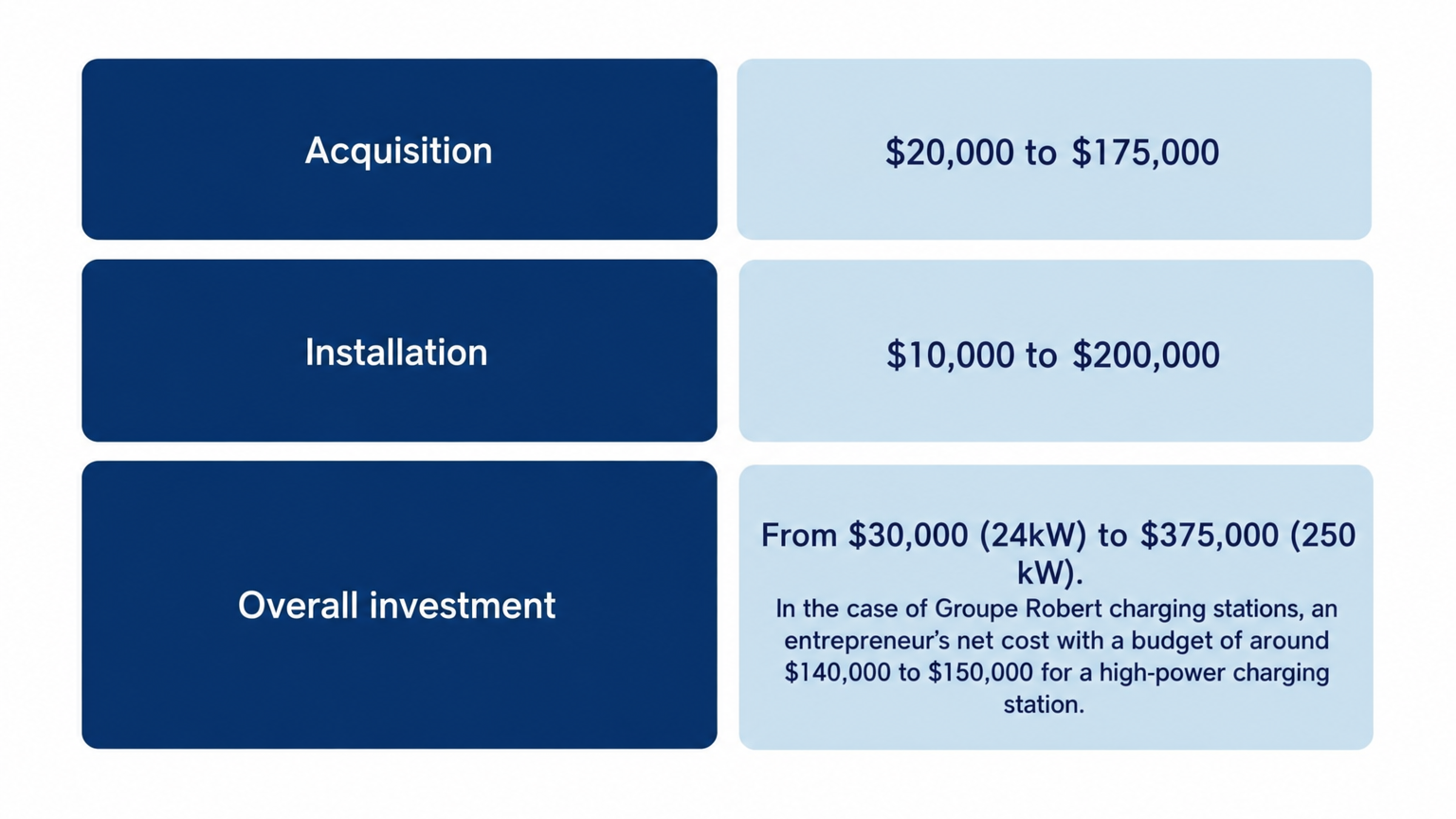
Several programs cover up to 50% of the costs; it is important to do your research to have up-to-date information on this. Recharge+ is one of these programs:learn more about Recharge+.
Tip
Divide the cost of a charger by the number of vehicles it serves.
With good planning and management software, multiple trucks can share the same charger.
"I plug two vehicles into each charger. On a lease basis, it works out to about $800 per month per vehicle, without having to invest nearly a million to upgrade our facilities," explains Martin Casaubon of Les Emballages Carrousel. Carrousel's case clearly illustrates the rapid development of financing solutions in the charging sector.
To avoid tying up capital and even to simplify their work, more and more companies are opting for:
- monthly leasing of chargers (OPEX) — fixed fees including equipment, installation, maintenance and sometimes energy optimization;
- charging-as-a-service models — where a provider takes charge of the entire system and bills at the charger or per vehicle;
- stretched financing, allowing costs to be amortized over several years.
These approaches greatly reduce the barrier to entry associated with initial investments (often several hundred thousand dollars) and accelerate the adoption of fleet electrification.
Energy savings confirmed in the field
Electricity proves to be a clearly more advantageous solution than diesel. According to the Innovative Vehicle Institute, energy-related cost savings realized range between 38% and 75% depending on applicable rates and adopted charging strategies.

Data collected in September 2024 at Les Emballages Carrousel illustrate this reality. For an electric rigid truck that traveled 8,700 km, the energy cost is $32.22 per 100 km, compared with $41.28 for a diesel rigid truck of the same category, a savings of 22%.
Charging strategy plays a determining role in these performances.
. "We favor charging at night, outside peak pricing periods," explains Martin Casaubon.
This approach, particularly advantageous for companies on the Flex G rate (a dynamic tariff that can, in winter, offer a lower price than the base rate), maximizes savings while ensuring vehicle availability.
Three practices make the difference:
- prioritize charging at the depot;
- schedule charging operations during lower-rate periods;
- limit the use of public fast chargers, whose costs can be considerably higher.
These operational adjustments, relatively simple to implement, turn the theoretical advantage of electric into concrete economic gains.
Maintenance costs
The streamlined mechanics of electric trucks transform the maintenance equation. With no oil to change, no exhaust system or particulate filter, these vehicles require considerably fewer interventions, although preventive maintenance remains necessary—for example on battery cooling systems or the transmission. According to the Innovative Vehicle Institute (IVI), annual maintenance costs average $7,000, compared with $11,000 for a diesel, a saving of 36%.
Kevin Lambert of Groupe Robert nevertheless specifies that "batteries and high-voltage wiring represent the most costly repairs, but they are covered by the warranty."
Charging stations, particularly high-power models, also require minimal maintenance that should be anticipated.
Insurance and related fees
The impact on insurance premiums remains modest in the case of Les Emballages Carrousel and Groupe Robert. Martin Casaubon of Les Emballages Carrousel estimates the premium at about $450 per vehicle annually, while Kevin Lambert notes that "with fleet insurance, the differences are negligible." Nevertheless, it is important to do your due diligence, as other operators report paying significant premiums to insure their electric trucks.
Some operators also invest in energy management software or telematics tracking to optimize their operational expenses.
Battery lifespan

Batteries are designed to last with the vehicle throughout its useful life, generally between 8 and 10 years, or even longer. Manufacturers offer extended warranties that minimize financial risk. Full replacements remain exceptional and are considered unlikely during the typical lifecycle of a truck.
The winning scenario
The Innovative Vehicle Institute has identified optimal conditions for electrifying a route:
- travel 200 km daily (about 40,000 km annually);
- return to the depot each day;
- charge overnight with a 50 kW charger;
- operate on a single shift and avoid public chargers.
Many other factors come into play (charger power, energy consumption, etc.), but according to a typical scenario analyzed by the Innovative Vehicle Institute, a Class 8 electric tractor recovers its investment in 2.23 years or 89,000 km (2024 analyses). Over an 8-year period, the total cost amounts to $355,994 ($1.11 per km) versus $475,811 for a diesel ($1.49 per km), generating savings of about 25%.
Electric excels particularly in repetitive urban routes with daily return to the depot.
It is even possible to make it even more profitable by running two shifts. The more an electric truck runs, the more diesel we save. However, you must find an operating mode that allows two shifts while limiting the use of fast charging, which is more expensive.
Nevertheless, this balance is fragile. Too many expensive charges or a few long downtimes caused by parts that are slow to obtain, for example, can quickly make reality different and lead to the electric truck being more costly to operate than its diesel equivalent. If this happens, do not be discouraged; on the contrary, continue to learn and improve—many operators face these challenges and still continue down the electrification path.
More demanding and costly contexts
There are several cases in which an electric truck will be more expensive to operate than a diesel truck. The profitability of the electric version diminishes when annual mileage remains low, when charging depends on public chargers, when vehicles operating on two shifts depend on depot charging that is too expensive, or when the charging infrastructure has been oversized.
Martin Casaubon openly acknowledges it: "To make it profitable, you have to drive about 14 hours per day. We're more around 8 hours, but we do it for the environment and for learning."
Maximizing profitability
Utilization intensity is the main lever of profitability. The more a truck is operated, the wiser the investment becomes. It should therefore be deployed on the most predictable routes and staggered schedules planned to increase utilization time.
"The important thing is to drive as much as possible, keeping a 20% battery margin," emphasizes Martin Casaubon.
Smart charging planning also makes a notable difference. Charging during off-peak hours and using software to distribute loads optimally helps control energy costs.
Driver behavior strongly influences consumption. Training teams in eco-driving and encouraging healthy competition among drivers generates tangible gains.
"Drivers challenge each other to improve their range," observes Martin Casaubon. Kevin Lambert insists on this point: "You have to educate the drivers, it's super important."
Finally, having a maintenance and contingency plan proves essential. A quick service agreement with the lessor or dealer and a replacement vehicle in case of immobilization protect operational continuity. "If a vehicle is immobilized for more than 4 hours, a combustion truck is lent to us," explains Martin Casaubon.
Assess your own costs
Several total cost of ownership calculators make it possible to assess the viability of an electrification project:IVÉO, NACFEand theInternational Energy Agency offer useful tools to achieve this.
Beyond the numbers: strategic benefits
Electrification transcends the simple financial equation.
"We do it for our environmental objectives, not for monetary reasons. We want to be among those who pave the way," says Martin Casaubon.
Early adopters acquire valuable know-how and will benefit from a competitive advantage as costs decrease.
This avant-garde position also responds to customers' growing expectations.
"We obtain contracts we might not have had without electric trucks," reveals Kevin Lambert.
Clients increasingly value carriers that take concrete action to reduce their carbon footprint.
Electrification also facilitates attracting and retaining drivers. The comfort, silence, and smooth driving of electric trucks appeal to drivers.
"It's more of a fight over who we assign them to than finding drivers!" exclaims Martin Casaubon.
In urban areas, the benefits are felt beyond the company's walls. "In the city early in the morning, we no longer disturb anyone," notes Martin Casaubon. The reduction in noise pollution improves urban quality of life and strengthens relations with communities.
Finally, station owners can generate revenue thanks to the Clean Fuel Regulations. Groupings like Swtch, Polara or Papillons Infrastructure facilitate the management of these carbon credits.
In conclusion
Electrifying a fleet can prove to be more economical or more costly than a fleet of diesel trucks. But moving forward is not just about a cost calculation. It is an approach of innovation, responsibility and strategic positioning that reduces our ecological impact and can even attract new customers. With rigorous planning, suitable use, and appropriate support, the electric transition becomes a sustainable investment for the company, its employees and the community.
"Ask lots of questions, do your research, and above all learn from others. Each experience advances the entire sector," concludes Martin Casaubon.


