


OPPORTUNITY AND FEASIBILITY STUDY
This study, carried out by Propulsion Québec, in partnership with WSP and several public and private partners, aims to assess the technical, operational and strategic feasibility of a charging corridor allowing 100% electric medium and heavy trucks to make long-distance trips between Québec and Toronto. This corridor constitutes a major logistical axis of interprovincial trade and a structuring lever for the decarbonization of freight transport.
Context
In 2021, GHG emissions from the transportation sector amounted to 150 Mt, or nearly a quarter of Canada’s total emissions. Freight transport alone accounted for one third of these emissions – a sector still largely dependent on diesel.
Despite a gradual adoption of electric trucks, the lack of public charging infrastructure adapted to Class 7 and 8 vehicles remains a major barrier, particularly for long-distance trips. This study takes place in a context where the governments of Québec and Canada are seeking to accelerate carbon neutrality while strengthening industrial competitiveness and reducing interprovincial barriers.
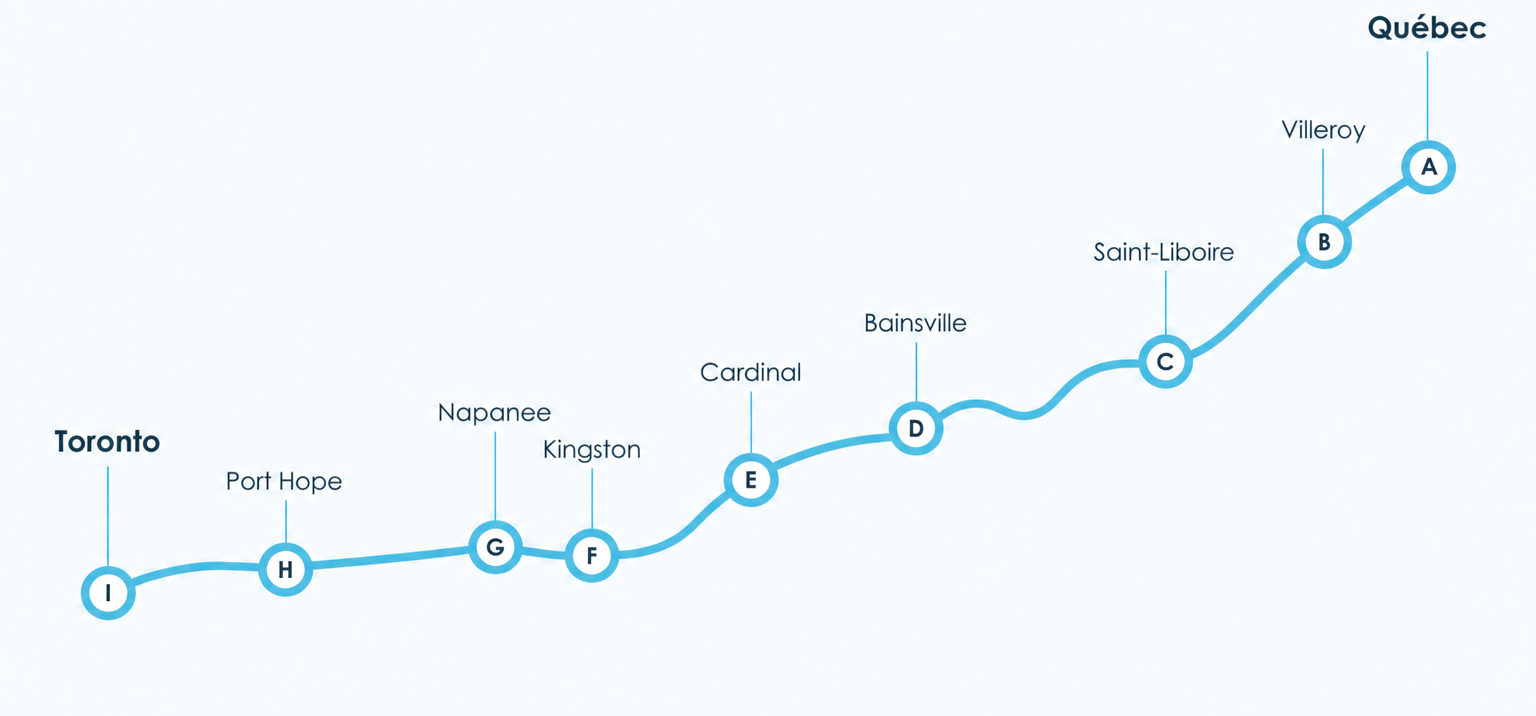
Here is an overview of the route and the location of proposed charging sites for this corridor project between Québec and Toronto:
Approach and methodology
This study, which comprises Phase 1 of the project, combines:
- a logistics analysis (truck flows, energy needs, carrier practices) ;
- a technology review of available and emerging charging solutions as well as heavy electric trucks currently offered on the market ;
- a operational feasibility analysis based on modeling of real scenarios (temperature, load, topography, range, charging).
The telematics data analyzed (notably by Attrix) made it possible to identify the most frequented strategic stopping points by heavy trucks and to associate specific charging needs with them.
Key findings
- Demonstrated feasibility : all modeled scenarios confirm that a Québec–Toronto trip by electric truck is technically feasible with current technologies, provided charging sites are planned at strategic locations.
- Structured route : seven priority charging sites have been identified between Québec and Toronto, spaced 60 to 150 km apart, allowing maintenance of a safe state of charge even under constraining conditions (winter, heavy load). A truck will not necessarily have to stop at each of them to recharge, but redundancy is planned in case of breakdowns or more difficult conditions.
- Charging as a key factor : direct current fast charging stations (DCFC) constitute the most mature, flexible and immediately deployable solution. Electric road technologies (catenaries, induction, rail) remain promising but are still not well-suited for short-term deployment in Canada.
- Controlled operational impact : the total travel time for an electric truck with an 11-tonne payload would require between 11% and 27% additional time to complete the trip compared to a diesel truck, if charging is integrated into drivers’ regulatory and operational stops (breaks, safety rounds, etc.).
Strategic findings
- The current public charging supply is insufficient and unsuitable to long-distance heavy-duty transport.
- Carriers currently favor private charging given that they do not travel long distances with electric trucks, but they recognize that a public or shared offering on the road is essential to secure and accelerate the electrification of corridors.
- The deployment of charging sites must go beyond energy and include services for drivers (safety, rest, food services), similar to initiatives observed in Europe and the United States.
Conclusions and outlook
The study concludes that a 100% electric truck corridor between Québec and Toronto is realistic, relevant and structuring for the energy transition of freight transport. The success of the project will rely on a close coordination between public, energy and industrial stakeholders, as well as on phased infrastructure planning.
The project positions Québec and Canada as potential pioneers of heavy-duty charging corridors in North America, with major climate, economic and industrial benefits.
Thank you to our partners
Propulsion Québec thanks the WSP teams for writing this report as well as for their valuable support throughout the project.
We also thank the financial partners who made this project possible: the Ministry of Transport and Sustainable Mobility of Québec, Hydro-Québec, the Scotiabank Climate Action Research Fund, Bornes Québec and Polara.
Major deployment partner

Major partners



Partners


Contributors




Operating partners