


New electric vehicle (EV) adopters — often called electromobilists or véistes — are discovering a new world: charging at public stations. It is therefore essential for everyone to understand the technical specifics of their vehicle in order to master its charging. Indeed, there is often confusion among new EV adopters.
What is a fast charging station?
Fast charging stations, also called BRCC (direct-current charging stations), are generally used during long trips. They are located in shopping centre parking lots or along highways to allow electromobilists to perform top-up charges and thus have enough charge to continue their journey.
A fast charge generally takes between 20 and 40 minutes, depending on the vehicle type, the charger's power, the battery's state of charge, the outside temperature and the battery temperature. Indeed,fast charging stationsprovide different power levels, which can reach 50 kW, 100 kW and more. However, for the same charging station, the power and charging time are not the same for all vehicles.
What determines the charging power at a BRCC?
It is important to remember that charging an electric vehicle at a BRCC is not done at a constant rate, because the vehicle dictates the power to the station. Indeed, the vehicle is equipped with software that adapts the requested power according to the type of charger and the battery's state of charge. Furthermore, it has been observed that the more charged the battery is, the less power it requests. This helps avoid battery heating and optimizes its lifespan.
Let's also recall that the power requested by the vehicle is optimal when the battery temperature is within a certain temperature range, which varies depending on battery type. Charging power can thus be reduced if the battery temperature is too cold — in winter, for example — or too hot, if it's warm or if there have already been several charges along the way.
What is the charging curve?
The charging curve is the evolution of charging power as a function of the battery's state of charge, and it is not the same for all EVs. Each manufacturer defines the vehicle's own curve via the onboard software, aiming to ensure the best compromise between charging speed and battery component longevity.
In practice, charging a battery is a bit like filling a bathtub to the brim. At first, you open the tap wide, then you gradually close it until at the end only a small trickle passes to avoid overflow. Charging an EV at a fast charger follows the same principle: power is maximal at the start, then is sharply reduced once the battery exceeds 80% charge.
Thus, power is usually higher at the start of charging. It is at that moment that the EV can accept maximum power. Then, the increase in temperature and in the battery's state of charge causes the EV to request less and less power, a decrease that can be gradual or in steps, depending on the model.
The only exception can occur at the start of charging in winter: when the battery is cold, power is sometimes low at first. It then increases as charging warms the battery. Once the battery is at the right temperature, it follows its usual charging curve.
Normally, the EV's maximum charging power is usually maintained for a certain time. For many recent models currently on the market, a power demand of more than 50 kW never lasts very long; it quickly drops below 50 kW. That's why we are only just beginning to install chargers of more than 100 kW.
What does a charging curve look like?
Here is a graph that shows the charging curve of three EVs.
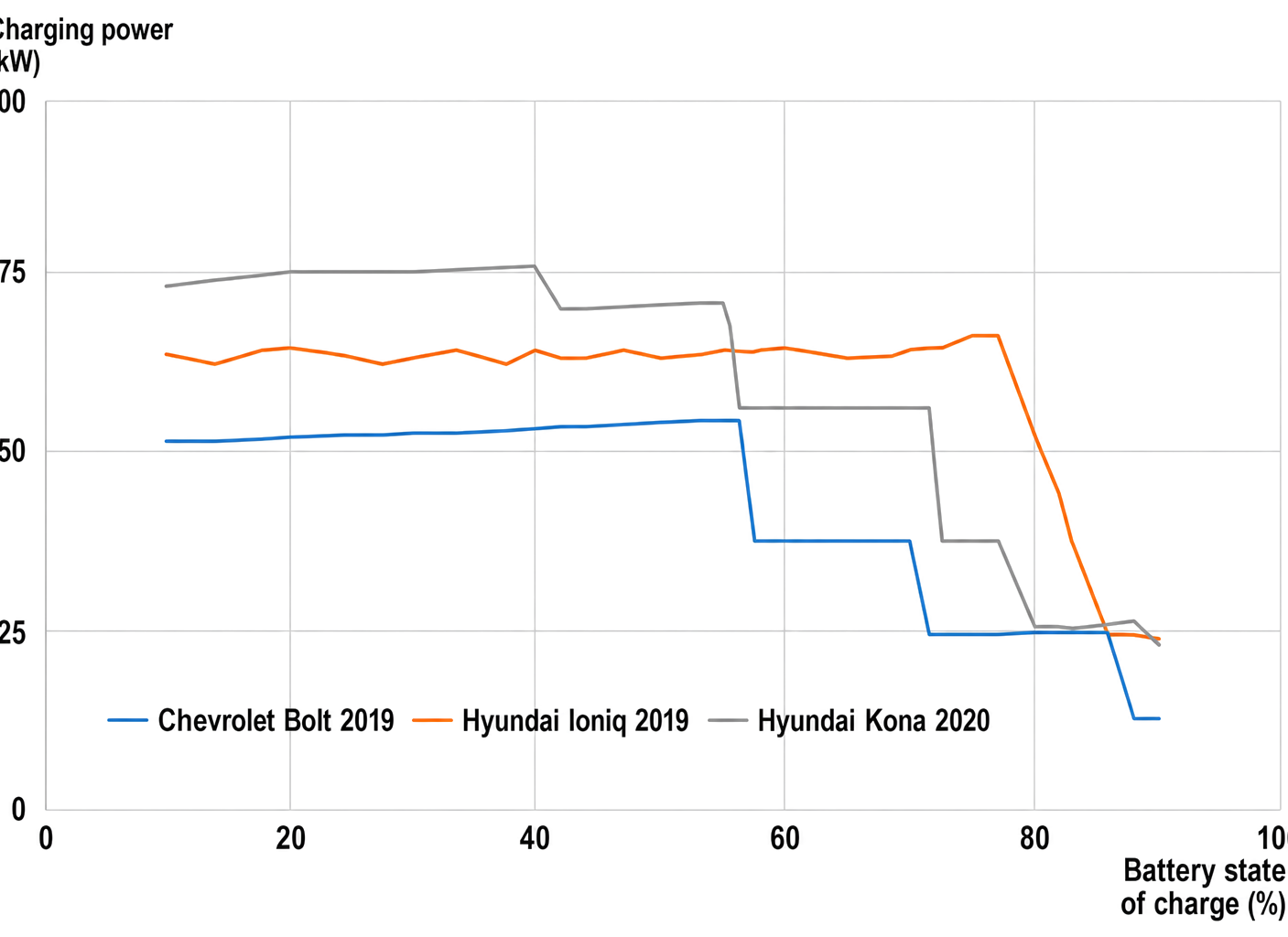
It clearly shows that:
- the Bolt maintains a maximum power of 50 kW up to a state of charge of 55%;
- the Ioniq maintains a maximum of 60 kW up to a charge of 75%;
- the Kona maintains 75 kW up to 40% charge.
The curves also show a progressive decline until full charge, following different profiles: gradual for the Ioniq and stepwise for the two other models.
The graph also shows that from a state of charge of 85 to 90%, the charging power falls below 25 kW. At that power, there is no longer any point in continuing to charge using a BRCC.
These curves were established with an optimal battery temperature. Outside of that temperature range, the power requested by the EV and supplied by the charger may be lower.
Learn more about the Circuit électrique powered by Hydro-Québec >>>
This partner content was produced as part of the Impulsion MTL 2020 event — the international forum on fleet management.


