


At a time when Quebec is committed to massively reducing its greenhouse gas emissions, public transit represents a key sector for our collective future, and plays an important role in managing the many challenges of road congestion. In this context, the electrification of public transport is also a vector for sustainable development and the fight against climate change.
Committed to the most ambitious and innovative project in its 50-year history, the Société de transport de Laval (STL) resolutely embraced electromobility in 2007. This will lead to the deployment of a fleet of 100% electric buses by 2040. This transition marks a major step forward for Quebec and the City of Laval, which will then be able to offer more ecological and eco-responsible passenger transportation.
To get the new fleet up and running, the STL also needs to carry out a number of interdependent projects, such as expanding its buildings, modernizing its operating systems, overhauling all its processes and adapting its technology to a constantly changing environment.
Updating and creating new infrastructure, whether technological or physical, requires major investment and high-level coordination. That's why the STL has set up an Electrification Transformation Office, whose aim is to coordinate the various interventions and projects, and thus support the vision of this historic shift.
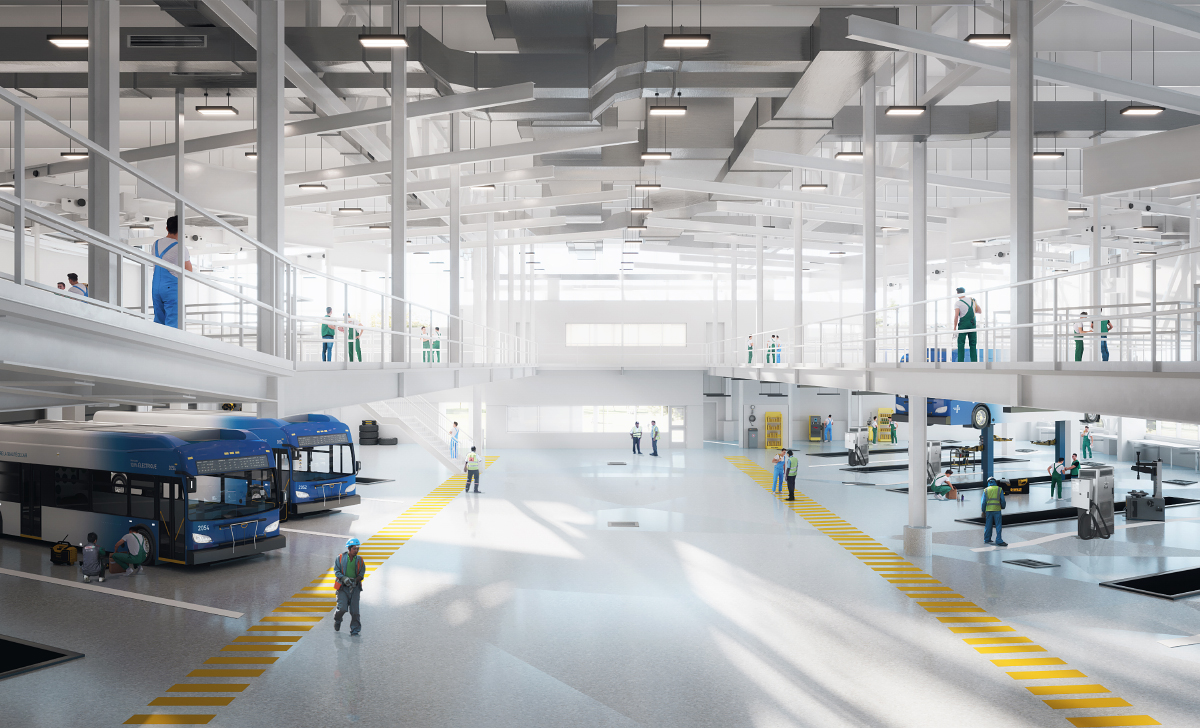
Among other things, the STL is currently expanding its garage, so as to be able to integrate the new electric buses into its service as early as 2026. This nearly $300 million project is the largest undertaken by the transit company since its creation.
The company can only meet this immense challenge if it relies on its employees, who are mobilized to undertake the in-depth transformation of processes and facilities. This means developing internal skills, adjusting roles, tasks and responsibilities, and recruiting new talent.
To provide this ecological and structuring solution, the STL will be training its employees to meet a need for specific expertise, particularly in fields that are widely considered to be the professions of the future. For many, this is a stimulating professional challenge that helps project the STL into the ranks of innovative transport companies.
The adoption of electromobility is paving the way for new employment opportunities throughout the transport sector. However, the scarcity of manpower, combined with the search for the skills needed to meet the new challenges of electrification, represents a major challenge.
Employees are at the heart of the process, as the key players in this change. Through numerous initiatives, the company is working assiduously to strengthen its most precious resource, by valuing the collaboration, recognition, development and sense of belonging of the members of its extended family. For the STL's strength is first and foremost that of a mobilized, competent and close-knit team.
Recognized as one of North America's most innovative and successful transportation companies, the organization deploys a sustained commitment to continuous improvement, which permeates all its practices and organizational culture. It has even been recognized in 2019 by the Government of Quebec and in 2021 by the Government of Canada with awards that represent the most important recognitions of organizational excellence.
Over the next few years, the STL will devote its efforts to combating climate change, while offering Laval residents top-quality public transport. Thanks to the contribution of its 1,100 employees, the STL is proud to make the leap to electrification a source of pride, while promoting the values of sustainable development and mobility.


