


We regularly hear about electric and intelligent transportation, but the two are quite different from each other. In this blog post, we will demystify intelligent transportation, introduce companies in this sector, and look at the key skills required to work in this fast-growing industry. Finally, it will be an opportunity to discover training and career opportunities in intelligent transportation in Quebec.
Intelligent transportation in Quebec
The intelligent transportation sector includes the entire ecosystem of companies and knowledge that make it possible to partially or fully automate vehicle driving. It also includes everything related to fleet optimization and large-scale data processing. When we talk about transport, our imagination automatically turns to cars, but they are only the tip of the iceberg!
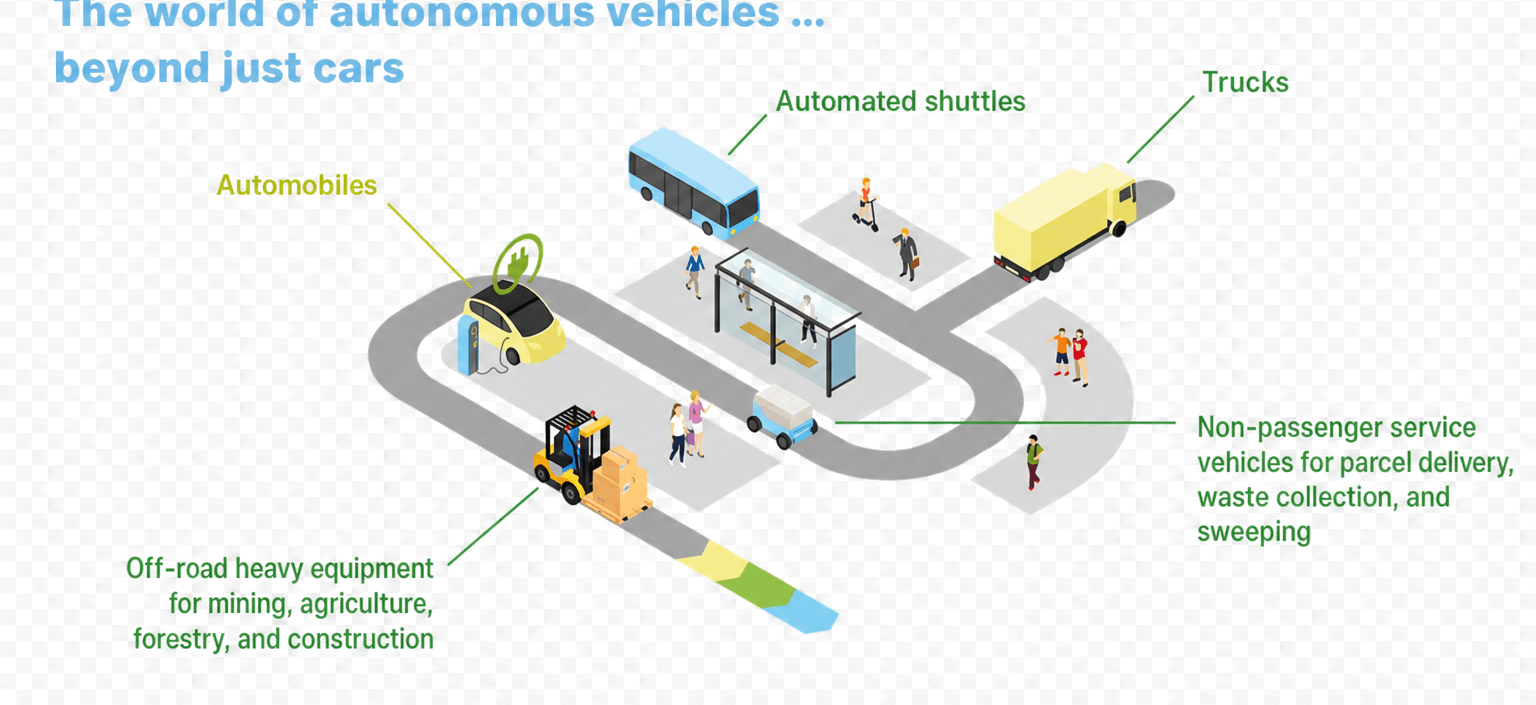
Over the next few years, vehicle automation will affect many segments:
- medium and heavy trucks;
- automated shuttles (many of which are used daily around the world);
- off-road heavy equipment for mining, agriculture, forestry and construction (a sector that is very advanced in automation);
- non-passenger service vehicles for parcel delivery, garbage collection, snow removal, etc.
Source:Information and Communications Technology Council and CAVCOE
Among the companies in the sector are notably:
- LeddarTech is a leader in detection and perception solutions for autonomous vehicles and advanced driver assistance systems;
- Algolux is a company working in artificial intelligence specializing in computer vision and image processing;
- Immervision is a leader in wide-angle and 360° panoramic imaging innovation;
- Orange Traffic specializes in traffic safety and optimization and intelligent traffic lights;
- AttriX, partenaire GéoTab au Québec offers telematics tools for optimized fleet management;
- Civilia provides practical and predictive solutions for large-scale data processing to optimize public transport routes;
- Jakarto is a high-definition mapping company.
Training and career opportunities
We group the various career possibilities in the intelligent transportation sector into two main families of professions:
- Photonics applied to transportation:photonics is the branch of physics that studies light. There is world-class expertise in Quebec. Photonic technologies include, among others, cameras, sensors, lidars, electronics and microelectronics, and image processing by software and artificial intelligence.
- Artificial intelligence and software:artificial intelligence is becoming increasingly important in many sectors, including transport with the development of autonomous vehicles, which will generate a phenomenal amount of data that must be processed to ensure driving and fleet optimization. This rapidly growing expertise is necessary for the development of intelligent transportation.
Among the possible career choices, here are 3 roles in the intelligent transportation subsector that are currently in high demand:
Optics and hardware designer for intelligent vehicles
The optics and hardware designer for intelligent vehicles is an expert in designing mixed-signal analog and digital circuits as well as optical systems.
Examples of tasks:Analyze and establish architecture requirements at the system level. Model the behavior of analog/mixed-signal and digital circuits and systems.
Skills sought:
- Knowledge in the design and evaluation of analog circuits and systems (TIA, ADC, FPGA, photodiode, laser driver, etc.), digital systems and opto-photonic systems.
- Knowledge in optical design and in performing simulations using optical technologies (e.g., LiDar sensors, wide-angle intelligent vision).
Examples of training*:
- Bachelor's degree in Electrical Engineering
- Bachelor's degree in Physics
- Bachelor's degree in Computer Engineering
Software and artificial intelligence designer for intelligent vehicles
The software and artificial intelligence designer for intelligent vehicles plays a key role in a team that develops machine learning solutions for the imaging systems embedded in autonomous and semi-autonomous cars.
Examples of tasks:Research and select automation tools, simulation methods, evaluation methods or algorithms for software design and server architecture of artificial intelligence for intelligent vehicles. Design, develop and deploy testing tools, simulation methods or autonomous driving algorithms.
Skills sought:
- Programming abilities with various languages (Python, C, C++, QML, GLSL, etc.).
- Excellent analytical skills, understanding and adaptability of systems and code.
Examples of training*:
- Bachelor's degree in Electrical Engineering
- Bachelor's degree in Physics
- Bachelor's degree in Computer Engineering
Algorithm, signal processing and image processing designer or specialist
The algorithm, signal processing and image processing designer or specialist has the expertise and ability to bring new contributions to applied research in algorithm design, signal processing and image processing.
Examples of tasks:Conduct literature reviews, research on concepts and research on product-focused algorithms and share knowledge. Plan and design test measurements and evaluation methods for algorithms.
Skills sought:
- Programming skills (Python, C, C++, TensorFlow, etc.).
- Skills for developing computer vision and artificial intelligence algorithms.
Examples of training*:
- Master's degree in Physics
- Master's degree in Electrical Engineering
- Master's degree in Computer Science
- Master's degree in Computer Engineering
- Master's degree in Statistics
- Master's degree in Mathematics
*Various training paths can lead to these positions.
Key skills required
At the RDV En route on March 30, 2021, Marie-Pier Fortier, Vice-President, Human Resources at LeddarTech, shared the key skills sought in candidates to work in this niche sector. She categorizes them into two groups: technical skills and non-technical skills:
Technical skills:
- Academic background in sciences adapted to the job requirements, combined with a constant appetite for learning;
- Various training, adapted depending on the position.
Non-technical skills:
- Bilingualism (the majority of clients are outside Quebec and Canada; proficiency in English is therefore essential);
- A great capacity to navigate ambiguity and ease in working in an ever-changing environment. As this sector is defined as it develops, one must be comfortable with frequent changes in working methods and in the product development cycle;
- Resilience, since companies are in a race against time to be the first to commercialize innovations. This constant pressure should not frighten candidates!
Ms. Fortier finally emphasizes that non-technical skills are as important as technical skills. Learning is continuous throughout one’s career since intelligent transportation workers evolve at the same pace as the industry.
Some advice from Marie-Pier Fortier to future candidates “Develop your intellectual curiosity, participate in webinars, panels and conferences likeRDV En route; that’s what opens your mind to the key skills required in the sector! Stay alert because the technology evolves quickly.”
In summary, the employees of the future will have to be increasingly versatile to enter the intelligent transportation sector. They will evolve at the very pace of the rollout and growth of this subsector, and will actively contribute to the development of tomorrow’s mobility!
To not miss anything about the next edition of RDV En route and about career and training opportunities>>> visit the En route web page!
Discover the key takeaways for a job in the world of intelligent transportation:


