


In this series of articles, we will demystify the major steps of a school bus fleet electrification project using the Transporteur+ guide. This guide aims to provide easy and direct access to resources, to clarify the steps, the issues as well as the conditions and facilitating measures for a successful transition to electrification.
The first crucial steps of your school bus fleet electrification plan are now complete. Did you know that it is just as important to plan the adaptation of your buildings and infrastructure from the very start of your project? Once your pilot project launched and your integration well underway, it is time to check whether your current facilities can accommodate electric school buses. Let's find out more in this blog post.
If your facilities do not allow you to recharge your vehicle fleet efficiently and safely, it's time to address this. Without recommending starting from scratch, it may be necessary to make modifications to the building or the site to charge and maintain your electric buses. Unless you have the appropriate internal resources, it is recommended to call on an external specialized service such as those described in section 4.2 of the Transporteur+ guide. These will ensure plans and specifications are validated, find qualified resources to carry out the modifications and oversee the work during the installation of electrical equipment and the reconstruction of infrastructure.
IMPORTANT
In addition to the charging installations, don't forget to check redundancy and electrical resilience installations to ensure continuity of operations in case of a power outage.
Does adapting the facilities require significant work?
Building and site adaptations vary significantly for each carrier, as they depend on a number of variables:
- The condition of the existing building ;
- The capacity of the electrical service entrance ;
- The location where maintenance will be carried out (on-site or off-site) ;
- The available space ;
- The distance between the facilities and the nearest utility pole ;
- Etc.
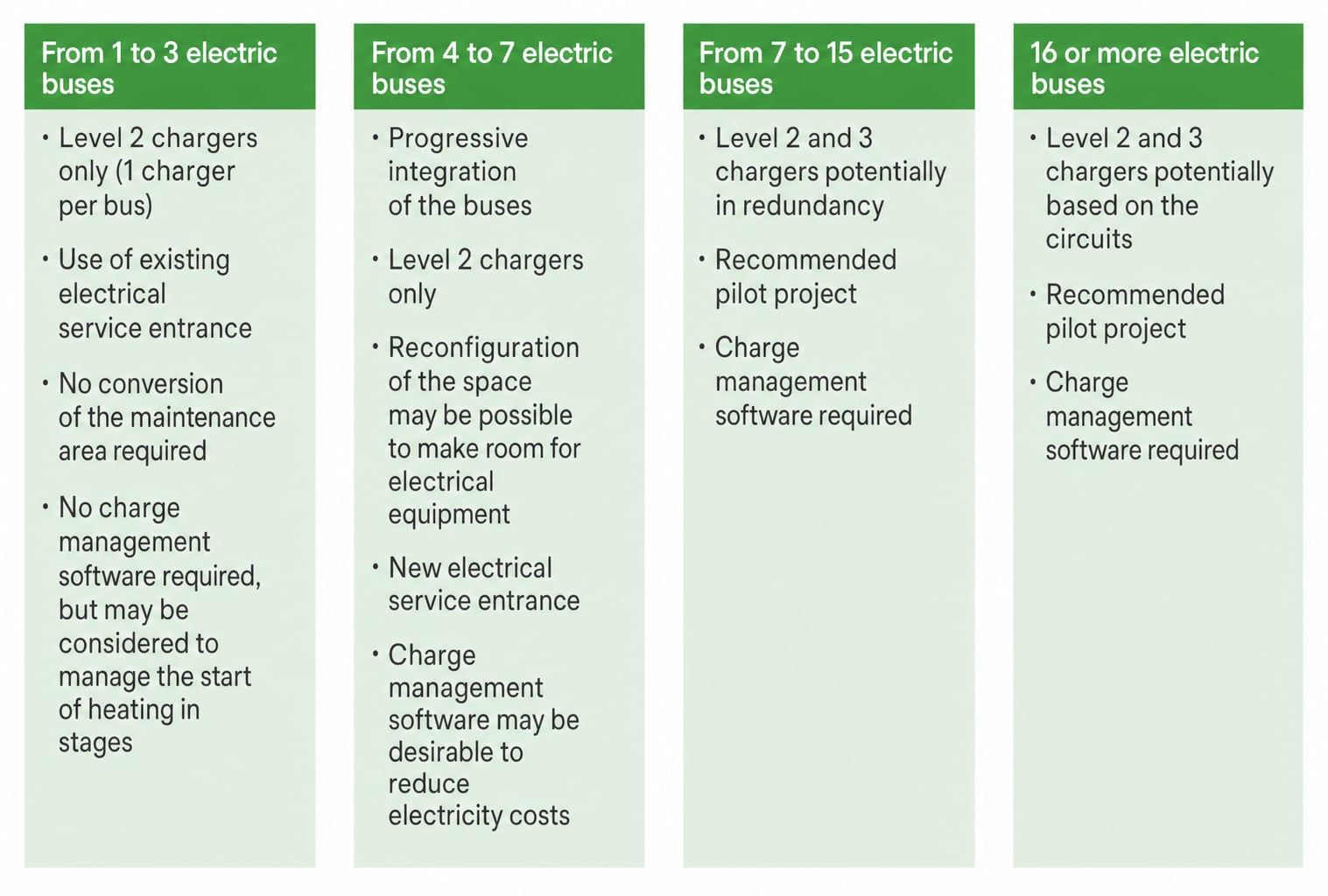
Here are the general rules that apply for fleets of different vehicle sizes. Note that a new electrical service entrance may be necessary starting at a fleet of three buses in most cases, because building electrical panels generally have little amperage available.
For more information, consult the web page of Transporteur+ and the guide Transporteur+.
This project is carried out thanks to the financial support of the Government of Quebec, the Trottier Family Foundation, the Greater Montreal Climate Fund and the Fonds de solidarité FTQ. Propulsion Québec also wishes to thank the organization L’Accélérateur de transition and the team at WSP Canada for their essential contributions, as well as all the experts met during the development of this guide.


