

Fleet managers are currently facing the colossal challenge of the energy transition in order to meet legislative requirements and societal demand. For the majority of carriers, both in the passenger transport sector and in last-mile delivery, this green shift has already begun.
The motivations behind this transition vary and are multiplying. Obviously, with environmental protection at the heart of everyone's concerns, achieving GHG emission reduction targets is now necessary to satisfy manufacturers' and governments' demands. companies' green plans in road transport are now a factor influencing recruitment and retention of staff and drivers. Another decisive element accelerating this energy transition is the historic rise in fuel costs. Breaking free from their dependence on diesel and its astronomical costs represents a major incentive for fleet managers now more than ever.
Although the purchase cost of an electric vehicle is between 20% and 150% higher than that of a combustion vehicle (including the subsidy), in the long term it is a profitable investment. According to the DOE (Department of Energy), parity in operating costs between these two types of vehicles should be reached by 2035, given ongoing technological advances. Today, despite the fact that supply is still relatively limited, dozens of electric truck models are available in the United States and Canada, and that number is increasing rapidly to meet demand. For example, electric models from several manufacturers such as Peterbilt and Kenworth are already available for delivery as early as the fall of 2022.
Of course, it is normal to feel unsettled given the scale of this transition, which involves major adaptations in terms of maintenance, charging management, driving habits, dispatching, and drivers' resistance to change. However, know that with the help of telematics, a business intelligence platform, and specialized support, it is possible to successfully electrify your fleet.
Here are some crucial steps in developing an effective action plan based on a precise analysis of your telematics data:
1-Establish objectives and appoint a committee including your telematics partners, your preferred equipment suppliers, experienced managers familiar with your operations, your customers, and your drivers.
2-Analysis of current fleet data (types of trips, distances, speeds, elevations, loads, weights, stops, stop durations, waiting times, detention times, trends in hours of service, operating temperatures, seasonality, fleet inventory, fleet growth trends)
3-Set realistic short-, medium- and long-term GHG reduction targets, including an inventory of clients' Zero Carbon requirements as well as their own strategies.
4-Recommendations and actions toward optimizing the energy consumption of current equipment (eco-driving, preventive maintenance, reduction of idling, and any other measures recognized for fuel optimization).
5-Planning and staged availability of energy deployment, power demand, and the availability of the customer's and their clients' infrastructure.
6-Availability of equipment according to evolving availability. Consideration of natural gas powertrains or other energy sources as a temporary alternative.
7-Planning of charging operations through an integration of the different telematics / Dispatch (TMS) / ERP / charging stations or other infrastructures.
8-Receipt of the first equipment, driver training in eco-driving.
9-Close monitoring of the pilot (consumption trends, challenges, reorganization).
By wisely exploiting your telematics data and putting at your company's service a business intelligence platform such as Lighthouse, the exclusive solution developed by the AttriX team, you will be able to successfully carry out the progressive electrification of your fleet. Here are some examples of what using such a platform allows you to do:
- Simplify analysis and decision-making regarding the electrification of your heavy trucks.
- Identify any vehicle in your fleet that meets the criteria favorable for substitution by an electric equivalent.
- Analyze frequent stops, identify and qualify on-route charging opportunities.
- Benefit from a comprehensive management tool for the fleet's electric vehicles.
- Accurately track the performance of electric vehicles and changes in battery charge levels.
- Supports more than 200 EV models including GM, Lion, Volvo, BYD and Tesla
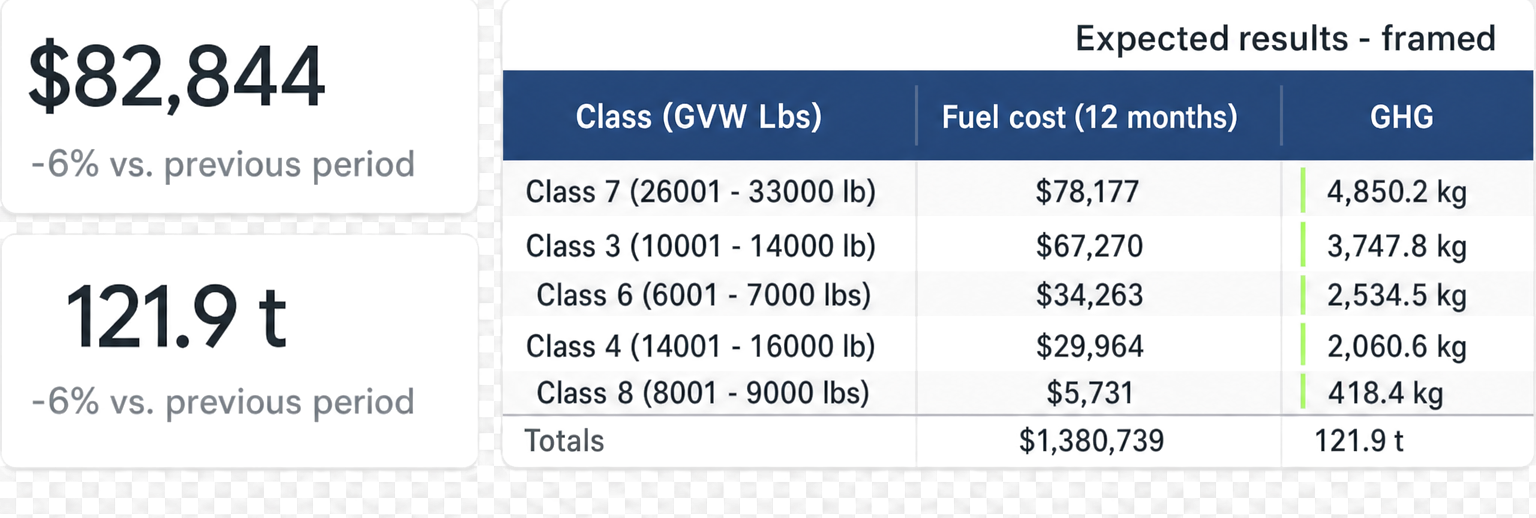
- Recognize and estimate for each vehicle the potential fuel savings and GHG emission reductions achievable through good eco-driving practices or through devices subsidized by the Écocamionnage program.
In short, it is essential to equip yourself well to effectively begin the electrification and energy optimization of your fleet, and one of the most useful and cost-effective solutions for this purpose is definitely telematics and the data intelligence it holds about your operations. Properly used, your data will allow you to establish a responsible strategy, through which you can decarbonize your operations, remain competitive, innovate, save in the long term, and enhance your company's reputation.
Did you know?
The use of a gamification and motivation solution for eco-driving for drivers can lead to a significant reduction in fuel consumption or a significant increase in range in the case of an electric vehicle. The Driver Challenge, designed by AttriX, has in fact demonstrated gains of up to 19% fuel savings and a reduction of 27% kW/h for an electric fleet.