


Background
The project, launched on February 19, 2020, aims to validate the viability of heavy electric trucks for the operation of an open-pit mine. A consortium of partners collaborated to electrify a Western Star 6900 XD truck, specially adapted to mining requirements. A dedicated charger was developed to recharge the vehicle, and the electric drivetrain was designed to meet the specific demands of the operation.
The design phase lasted until September 2020, including simulations and tests to optimize the vehicle sizing. After approval, a detailed design was developed through September 2021, leading to the vehicle's assembly in December 2022. The truck's testing took place intermittently between January 2023 and March 2024, in part due to the desire to test it under different climatic conditions.
Three testing periods:
- January to April 2023: operational tests of the safety systems (parking at the IVI)
- April to August 2023: controlled-condition tests and performance validation (conducted on the road near the IVI)
- August 2023 to March 2024: real-condition testing at Uniroc
Project objectives
- Demonstrate that 100% battery electric mining vehicle technology meets industry needs and can find a place in open-pit mining operations in Quebec ;
- Validate the design assumptions of the electric prototype (powertrain, battery, thermal management and vehicle control) and of its charging system ;
- Acquire data to optimize the use of the electric prototype in representative operational situations (energy savings and reduction of production costs) ;
- Evaluate the greenhouse gas (GHG) reductions of this new technology compared to existing technologies ;
- Convert a diesel truck into a fully electric version adapted to the specificities of mining operations ;
- Carry out tests in a controlled environment to evaluate the truck's proper functioning (brakes, drivetrain, safety) ;
- Validate the operating ranges of the vehicle's systems in controlled real-world conditions and compare the results with the design specifications ;
- Test the vehicle in a real operational cycle including loading, transport, unloading and return empty, to simulate mining operating conditions ;
- Collect data for software debugging, performance validation and the operation of the vehicle in varied contexts ;
- Test a dedicated charging station, developed to meet the electric truck's energy needs, at another mine site after testing.
Project methodology
- Identification of needs : analysis of the performance of diesel and electric vehicles, taking into account the 11.7% reduction in payload capacity due to the addition of batteries and the impact on total weight.
- Development of solutions : proposal of several configurations to optimize the electric propulsion while taking into account the constant electric torque compared to the diesel engine.
- Design of the charging infrastructure : development of a 1 MW charging station adapted to the mining industry and use of standard charging stations, including a Level 3 charger (ABB, 24 kW) for tests at the IVI and a Level 2 charger (EVduty, 19.2 kW) for tests at Uniroc, although the power was adjusted to 12.44 kW for technical reasons.
- Data collection :
- Implementation of a data acquisition system to collect quantitative data on vehicle performance via CAN buses, with sensors to measure temperature, acceleration and location.
- Collection of qualitative data through a dedicated driver, allowing for consistent and valuable feedback.
- Test phases :
- Phase A – parking: Validation of the proper functioning of the vehicle's systems, including hydraulic, pneumatic and safety systems.
- Phase B – closed construction road: Characterization of the vehicle's performance and range, conducting spot tests and a test circuit. Measurements of vibrations on the batteries to confirm the mechanical design assumptions.
- Phase C – Uniroc quarry: Carrying out real-condition tests on varied routes, taking into account differences in load and temperature. Analysis of the results to estimate the vehicle's performance.
- Monitoring and adjustments : continuous evaluation of the collected data to refine the vehicle's performance and make necessary adjustments, while ensuring that the systems meet mining operation requirements.
Results obtained
The electric vehicle trial project produced varied results across three distinct routes. The tests revealed particularly encouraging performance, notably in terms of range and energy consumption, with notable variations depending on route conditions.
Test results
- Route performance : the most efficient route covers a distance of 37 km, a maximum elevation change of 30.4 m, and an average speed of 9.2 km/h. Conversely, one of the routes, although shorter, showed significantly higher energy consumption.
- Range and consumption : estimated ranges varied between 422 and 585 minutes, while electrical consumption fluctuated from 4.51 kWh/km to nearly 10 kWh/km. The effect of temperature on range was also evaluated, indicating a loss of about 19.7% in winter. A full recharge of the vehicle provides 6 to 9 hours of range (depending on temperature) in the conventional operational context of an open-pit mine with 80 m elevation.
- Greenhouse gas (GHG) savings : If used in Quebec, the electric mining vehicle allows for up to three times lower GHG emissions (66%) over the truck's total life cycle according to previous estimates. With its use, savings of more than 400,000 liters of diesel over the truck's lifetime can be observed.
- Charging efficiency : the chargers showed charging times ranging from 23.1 hours to 61.1 hours depending on power since these are 'low-power' chargers. A fast-charging potential at 1 MW could reduce this time to 1–1.5 hours in a commercial use context.
- Economic analysis : the estimated operating costs over 10 years showed that the electric vehicle, although slightly more expensive to operate with a 475 kW charger (+0.5%), could become more economical with a 50 kW charger, showing a cost reduction of 66.07% compared to diesel. Ownership cost, meanwhile, increases by 18.99% with a 475 kW charger and decreases by 9.75% with a 50 kW charger.
Qualitative comments
Driver feedback highlighted performance comparable to, or even superior to, diesel vehicles, despite some technical issues encountered with the batteries since the truck was a prototype. Vehicle startup delays and the need for fast charging were also highlighted as areas for improvement.
An IVI report demonstrated the potential of the electric vehicle in an operational environment, while identifying avenues for optimization for range, charging and reliability. The results suggest that, despite the challenges encountered, switching to an electric vehicle could offer significant long-term economic and environmental benefits.
Next steps for stakeholders
Since the end of the project, the electric mining vehicle has been returned to the NMG mine site. It will primarily serve as a demonstrator and could potentially be used for light work. For now, everything is going well and training for the employees involved in this sector is scheduled for December 2024. NMG used the electric truck in demonstrations, and plans to use it for a small construction project to be carried out this fall. The truck will be used to move rocks, stumps and soil on the mine site.
For their part, other stakeholders such as Propulsion Québec, the Innovative Vehicle Institute (IVI) and the NRC are working to publicize the project's findings.
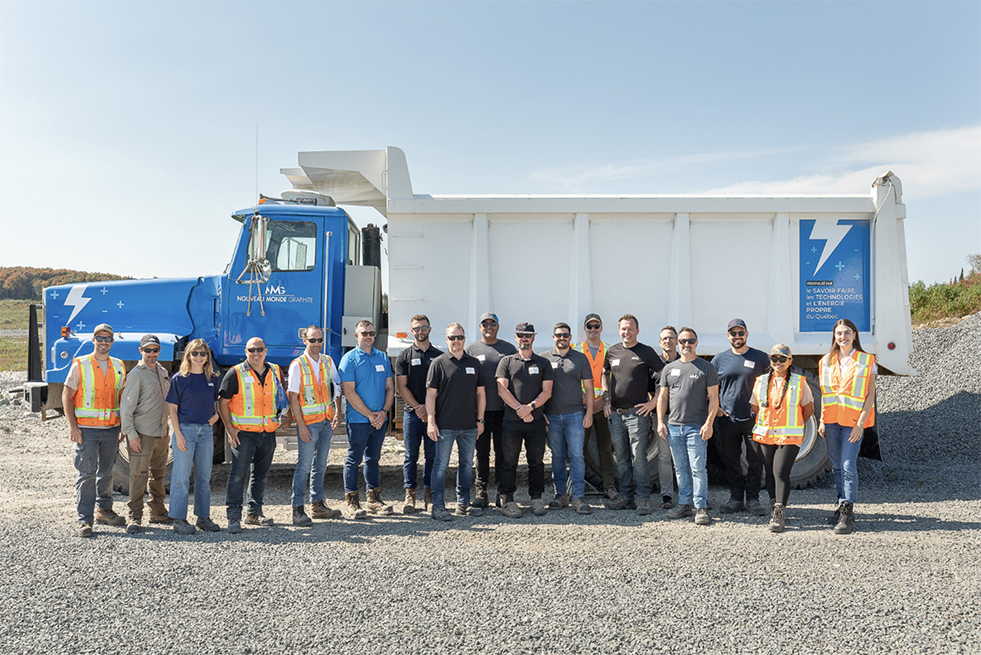
Partners and funding
This project is an initiative of theInnovative Vehicle Institute, carried out with Propulsion Québec, involvingAdria Power Systems,Dana TM4,Fournier & Fils andNouveau Monde Graphite as industrial partners as well as theNational Research Council Canada (NRC) andCANMETMines as research partners. The project is carried out thanks to the financial participation of the Innovation and Clean Growth in the Natural Resources Sectors Program, the Innov-R program and the Mining Research and Innovation Support Program (PARIDM). The project also receives financial contribution from the Plan Nord Initiatives Fund and the Industrial Research Assistance Program (IRAP).
We also wish to thankUniroc for hosting us for the field tests.
Conclusion
The in-depth tests carried out on the electric vehicle demonstrate that it is well suited to the demands of open-pit mines in Quebec. Despite higher elevation changes in mines, our range estimates of 3.5 hours for one hour of charging remain consistent with the initial objectives. This highlights the need for careful operational planning to optimize its use.
In terms of performance, the electric vehicle competes with diesel trucks, notably in climbing speed, which is essential for productivity. However, it has an 11.7% reduction in payload capacity when transporting material and limitations in operation cycles depending on the chargers. Economically, although acquiring an electric vehicle is more expensive, operating costs could be comparable to, or even lower than, diesel vehicles, especially with optimized charging infrastructure.
Our experience suggests that the quarry sector is also ready to adopt this technology, with minimal adjustments. However, challenges remain, particularly with regards to charging infrastructure. It is essential to accurately anticipate each site's energy needs and to validate the availability of electrical inputs. Depending on specific needs, higher charging powers may be required, which may not always be compatible with existing electrical inputs. Moreover, reliability remains an issue. Although most problems can be fixed in an improved version, the current vehicle was designed to prove technological viability, not optimized for commercial production. It is therefore essential to collaborate with a manufacturer capable of bringing this technology to a higher level of maturity to ensure its commercial success.


