


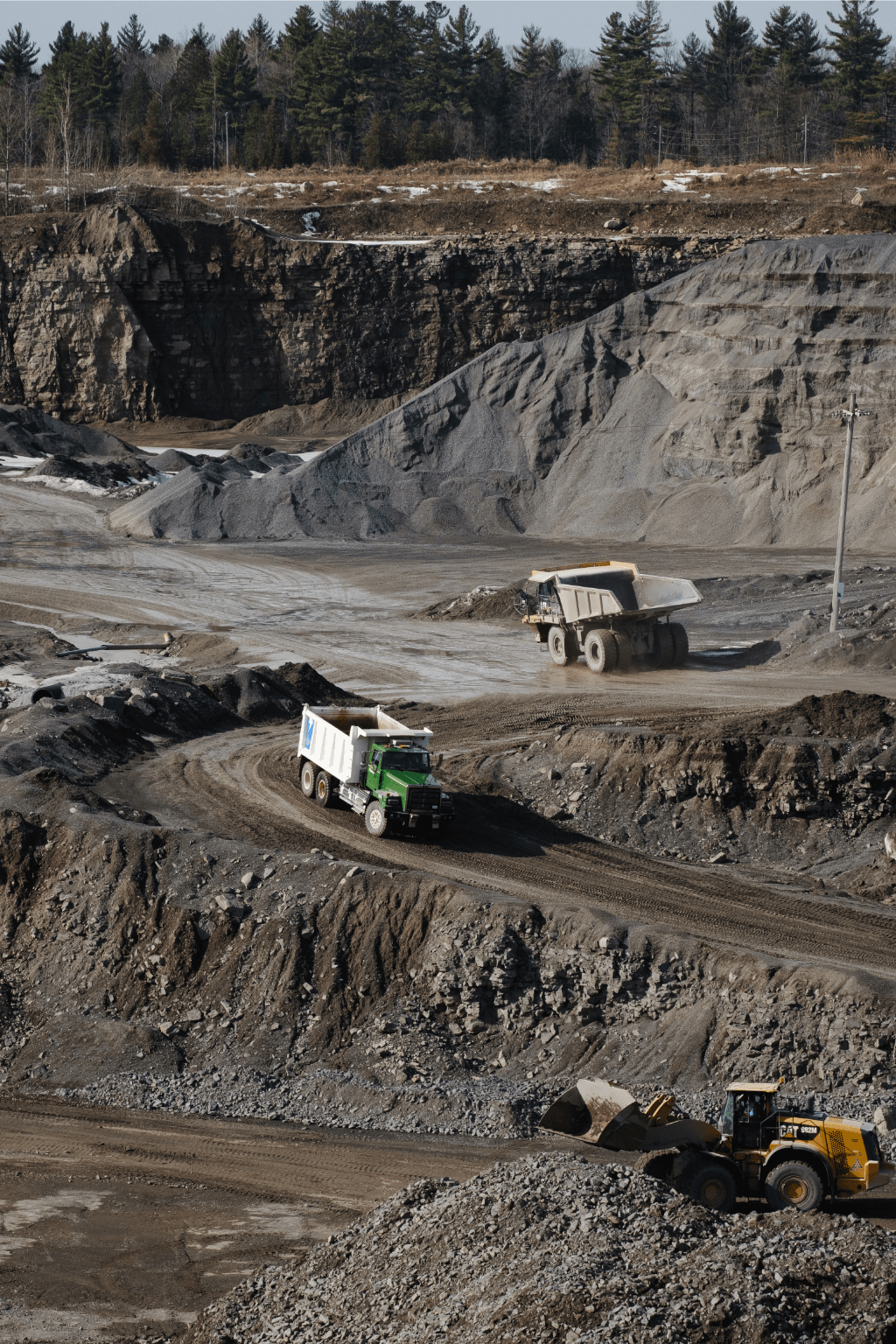
The mining industry is facing increasing environmental and economic challenges and the transition to more sustainable solutions has become a necessity. In this context, the electrification of mining vehicles appears to be a promising solution. To assess whether this technology is ready for large-scale deployment, we spoke with three partners closely involved in the creation of the first 100% electric 40-ton mining vehicle for open-pit mines and its field testing: Eddy Zuppel, Program Lead, Clean and Energy-Efficient Transportation and Guillaume Imbleau-Chagnon, Senior Project Manager, at the National Research Council Canada (NRC), Désirée Tremblay, Head of Innovation and Financial Strategy at Dana TM4, and Jérémi Fournier, President of L. Fournier & Fils.
Partnerships and involvement
Eddy Zuppel of the NRC details their contribution: "It was important, early in the project, to model and simulate the vehicle's powertrain to understand its energy requirements and design an optimal battery pack. We also tested the battery modules to ensure their performance and safety, and carried out a life-cycle analysis to assess the potential reduction in greenhouse gas (GHG) emissions."
As for L. Fournier & Fils, Jérémi Fournier shares his company's vision: "We are one of the largest mining contractors in Eastern Canada. As a partner, we provided a diesel truck platform for the electric conversion. We also shared historical operational data to compare performance. Our goal is to reduce the carbon footprint of our operations while increasing efficiency."
Désirée Tremblay explains that Dana TM4, specialized in the manufacture of electric propulsion systems for various vehicles, including off-road vehicles, supplied a high-power electric motor for this project. "We worked closely with the Innovative Vehicle Institute (IVI), also a partner on this project, on integrating the motor into the truck's existing transmission, ensuring that it could withstand the high vibrations characteristic of mine roads."
Promising prospects despite the challenges encountered
Guillaume Imbleau-Chagnon, of the NRC, specifies that the modeling and simulations made it possible to correctly size the battery pack. However, the precise data will be available this summer, and they will help design new electric trucks or assist mining operators with their energy needs. Throughout the development process of the electric mining vehicle, the partners interviewed faced several challenges during the vehicle's design and manufacturing. Eddy Zuppel of the NRC highlights supply problems for battery cells for the prototype vehicle, adapted to off-road vehicles, while his colleague Guillaume Imbleau-Chagnon mentions the limitations of the test sites. "We were not able to test the high-power charger, which restricted our data on vehicle recharging." Indeed the charger will be tested later at another mine site. From Dana TM4's side, Désirée Tremblay emphasizes that the robustness of the bearing system was crucial. "We used ceramic and iron bearings capable of withstanding partial electrical discharges." The field tests are completed and the conclusions will be shared soon.
Outlook and innovations
The outlook for electric mining vehicles is promising. Jérémi Fournier is optimistic: "If tests confirm that the charge cycles and range meet the needs, this technology represents the future of the mining industry." Désirée Tremblay and Eddy Zuppel stress the importance of technological adaptation. "Each mine site is unique, so vehicles must be specifically adapted to their operating conditions," explains Désirée. Eddy adds that operational benefits, such as reduced vibration and noise, can improve safety and operator satisfaction.
Experts nevertheless anticipate continuous improvements. "Battery costs continue to fall, their safety increases and system efficiency improves. These advances will make electric vehicles increasingly attractive," says Eddy Zuppel. The transition to more sustainable solutions requires careful planning. Jérémi Fournier highlights the need to standardize certain aspects to reduce costs and simplify logistics, such as battery packs and charging infrastructure. Guillaume Imbleau-Chagnon, for his part, envisions modular platforms that allow flexibility adapted to the specific needs of each mining operation.
In conclusion, although challenges remain, the partners are convinced that electric mining vehicle technology is well on its way to transforming the industry. Ongoing tests and future innovations will play a crucial role in this transition. Preliminary results show that these vehicles can not only meet operational requirements but also offer significant benefits in terms of sustainability and performance. The future of electrified mines looks promising, with potential for cost reductions, improved safety, and decreased GHG emissions.
About the partners
National Research Council Canada (NRC)
The NRCpartners with Canadian industry to take research out of the laboratory and find commercial applications whose benefits will accrue to the entire population.
Dana TM4
Dana TM4is a joint venture of Dana Incorporated and Hydro-Québec. Dana TM4 develops and manufactures electric motors, generators, power electronics and high- and low-voltage control systems for the commercial, passenger, sports and recreational vehicle markets as well as for the marine, rail and mining sectors.
Dana TM4 contributes to the highest possible energy conversion efficiencies thanks to its expertise in permanent magnet motors, thermal management, winding, external rotor topology and control algorithms.
L. Fournier & Fils
Large-scale mining contractor in Eastern Canada, L. Fournier & Filsoffers an integrated range of high-quality products and services to effectively meet the evolving needs of its customers. Its activities are primarily focused on surface mining work, notably in the areas of bulk excavation, formwork and concreting, crushing, and transportation.
This project is an initiative of the Innovative Vehicle Institute, carried out with Propulsion Québec, involving Adria Power Systems, Dana TM4, Fournier & Fils and Nouveau Monde Graphiteas industrial partners as well as the National Research Council Canada (NRC) and CANMETMinesas research partners. The project is carried out thanks to financial participation from the Clean Innovation and Growth Program in the Natural Resources sectors, the Innov-R program and the Mining Research and Innovation Support Program (PARIDM). The project also receives a financial contribution from the Plan Nord Initiatives Fund and the Industrial Research Assistance Program (PARI).
We also wish to thank Uniroc for hosting us for the field tests.
Photo credit: Sylvie Trépanier.


