


The new Clean Fuel Regulations, SOR/2022-140, (the "Regulation") aims to replace the use of fossil fuels and promotes the use of electric vehicles and hydrogen fuel cell vehicles.
To do this, the Regulation establishes carbon intensity limits for gasoline and diesel, which decrease year after year until 2030 as shown in the following table, taken from section 5 of the Regulation:
Fuel carbon intensity limits
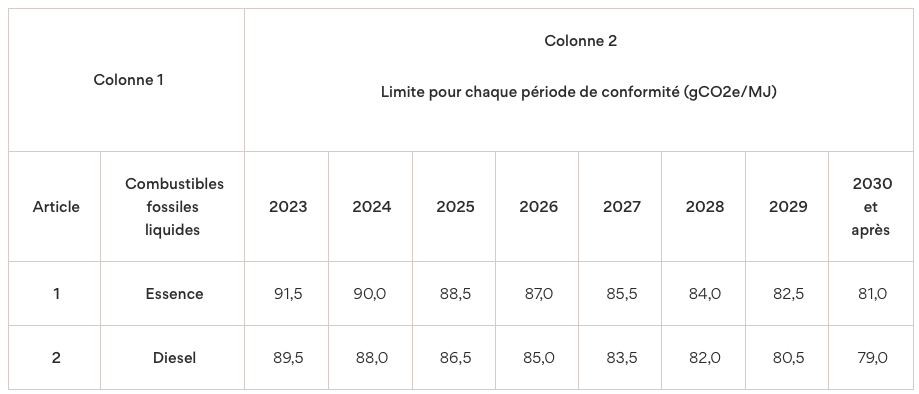
Entities that own gasoline and diesel production facilities in Canada, or that operate, control or manage them, or that import those fuels, are called "primary suppliers" in the Regulation; they are subject to the Regulation if they produce or import in Canada a volume of gasoline or diesel of 400 m3 or more during a compliance period. To enable primary suppliers to comply with their greenhouse gas emission reduction obligations, the Regulation uses the tool of "compliance units." A compliance unit is deemed to reduce by one metric tonne the quantity of CO2e emitted by the fuel over its life cycle during the compliance period.
The objective of promoting electric vehicles and the objective of replacing the use of fossil fuels converge in a way: on one hand, primary suppliers have an interest in acquiring compliance units to meet reduction requirements and on the other, the Regulation allows entities that operate charging stations, which the Regulation calls "charging-site hosts," to create such compliance units, units that the host may sell to a primary supplier.
Charging-site host
The Regulation thus defines the notion of a charging-site host:
Owner or tenant of a charging station legally authorized to have it installed. (charging-site host)
And the notion of "charging station" is defined as follows:
Device used in Canada to charge the battery on board an electric vehicle by supplying electricity to the electric vehicle and equipped with the ability to communicate with a server via the Internet, by cellular signal or by communicating vehicle to report the time and quantity of electricity supplied. (charging station)
Registered creator and compliance unit creation agreement
A person who intends to create compliance units must be recognized as a "registered creator" by the minister.
Note that the registered creator may enter into a compliance unit creation agreement with a person who carries out a CO2e emissions reduction project. In particular, CO2e emissions can be reduced by entering into a compliance unit creation agreement with the host of a charging station.
The registered creator can create compliance units using a quantity of electricity as an energy source. For this, the electric vehicles must belong to one of the categories mentioned in the specifications for calculating carbon intensity by means of the Fuel Life Cycle Assessment (LCA) Model, and in the case where the charging station is not one that belongs to the occupants of a private dwelling and is primarily intended for their use or by a public charging station.
Formula
The Regulation provides a formula to determine the number of compliance units. The formula, quite complex, takes into account in particular the following elements:
- The difference between the so-called reference carbon intensity for gasoline and diesel and the carbon intensity of the electricity used by electric vehicles;
- The quantity of electricity supplied to electric vehicles.
Mechanism for the transfer of compliance units
Once compliance units have been created, they can be sold using the compliance unit transfer mechanism.


