


Propulsion Québec is offering the Transporteur+ guide, which aims to provide easy and direct access to resources to clarify the steps, challenges, and the conditions and enabling measures for a successful transition to electrification.
Propulsion Québec wishes to thank all the experts consulted during the development of this guide for their essential contribution.
THE PRODUCTION OF THIS GUIDE WAS MADE POSSIBLE THANKS TO THE FINANCIAL SUPPORT OF:



THANKS TO OUR IMPLEMENTATION PARTNERS:


A technical guide on the electrification of Quebec school buses to successfully carry out the transition
Consult the guideDescription and objectives
Electric buses are an important solution to transform school transportation into a more sustainable, efficient, and resilient long-term alternative. Although this technology shares many similarities with standard diesel buses, it is important to understand what makes it unique in order to better prepare for its arrival.
This technical guide presents a review of electric bus technologies and their charging systems, their future developments, and the key steps to consider to ensure successful deployment. Its purpose is to demystify the work to be planned for the transition, identify the operational requirements of the technology and provide solutions to meet them, and to propose concrete courses of action for carriers to approach this technological shift by 2025.
Since financing and subsidy opportunities are multiplying, it's the right time to begin the transition process.This guide is primarily intended for small and medium school bus operators (up to 50 buses)who will find the necessary information on the electrification of school buses and on the first steps to accomplish their energy transition.
Why this guide?
According to a recent survey, nearly 535,000 schoolchildren travel by school transportation morning and evening in Quebec, representing nearly 60% of enrolled students. When it comes to electrifying school transportation, this figure highlights the scale of the impact this transition will have on our society and the number of Quebec families who will benefit from it.
By presenting its Plan for a Green Economy aiming to convert 65% of school buses to zero-emission vehicles by 2030, the Government of Quebec emphasizes electrification. Several financing programs have also been put in place to support the gradual adoption of the different technologies involved.
To reach government targets, Quebec school bus operators therefore must act in unison. This transition presents a tremendous opportunity for Quebec carriers to operate zero-emission vehicles and to pave the way for other operators who can follow suit toward more environmentally friendly technologies.
We believe that the key to the success of electrification projects lies in understanding the challenges to be met and in well-defined planning. This guide aims to present all the necessary steps to facilitate your electric transition and ensure you optimize your transition process.
According to the Ministry of Transport, the potential greenhouse gas emissions reduction from an electric school bus would amount to 23 tonnes of CO2 annually, equivalent to five cars consuming 2,000 L of gasoline per year.
Key steps to follow
KEY STEPS TO ELECTRIFY YOUR SCHOOL BUS FLEET
Planning
Planning your electrification project is the foundation of a successful transition. At this stage, you must first put on paper your short-, medium- and long-term vision. How many buses need to be replaced each year? What are my daily range requirements? What will my future electrical needs be? These questions help set the framework for the transition plan. The planning phase can take up to a year to best prevent complications related to future installations.
Selecting your bus, charger, and software suppliers
When discussing an electric bus adoption project, the system must be considered in its entirety: the vehicle, its charging infrastructure and the operations and planning software. This guide offers questions to ask to help select bus or service suppliers. Key elements surrounding battery capacity and lifespan, the availability of specialized labor for heavy repairs, and lead times are raised in the list of questions.
Implement a pilot project and progressive integration
At this stage, the financial structure must be completed. Implementing a pilot project allows teams to test and push the limits of the technology to understand its constraints, establish new organizational processes while training employees, and adapt their adoption strategy to local particularities (distances, climate conditions, road types, etc.). After six to ten months of pilot project implementation, it is recommended to perform a feedback analysis to correct any issues before introducing the next electric buses. The pilot project should last a minimum of one year to collect data on the full range of seasonal variations.
Adapt buildings and infrastructure
To avoid having electric buses idle during construction work, it is important to plan your schedule so that infrastructure is ready to receive buses before they are delivered. This stage is estimated to take between six months and a year and a half, depending on the complexity of the work to be carried out, which can vary greatly from one carrier to another.
Commissioning and operation
The infrastructures are installed and the electric buses have been delivered: only testing them on regular routes remains. There are not yet standardized industry tests to verify bus performance. It is therefore recommended to carry out as many tests as necessary for drivers to get used to the new buses and their charging systems. It is also at this stage that teams will become familiar with charging management software and real‑time data visualization.
Services offered and financing
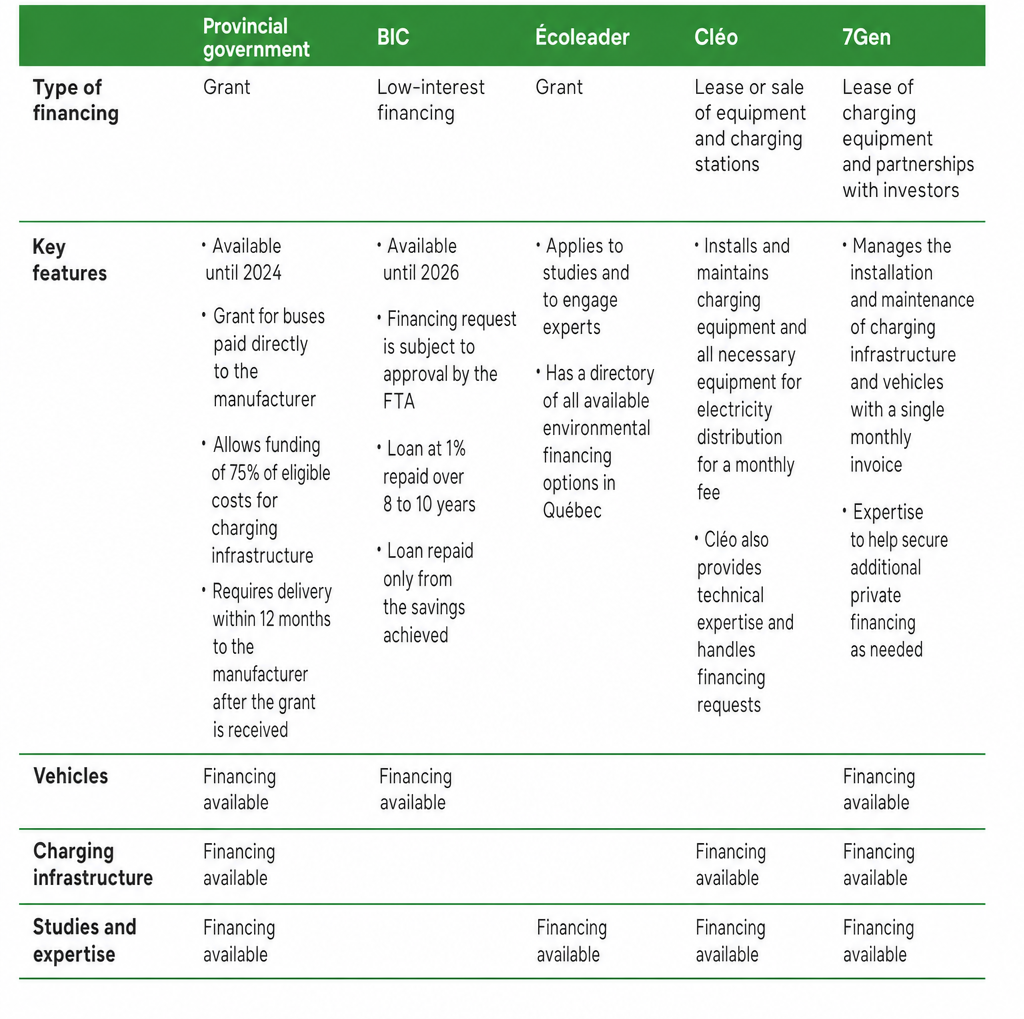
There are government grants that can cover nearly one third of the acquisition cost of electric buses, and 75% of the installation costs of chargers and the studies necessary for their deployment. The Canada Infrastructure Bank, in partnership with the FTA, offers financing at a very low interest rate that is only repaid if savings are realized through the deployment of electric buses.
The table below presents a summary of the financing options currently available and presented in Section 4 of the guide, from page 30 to page 33.
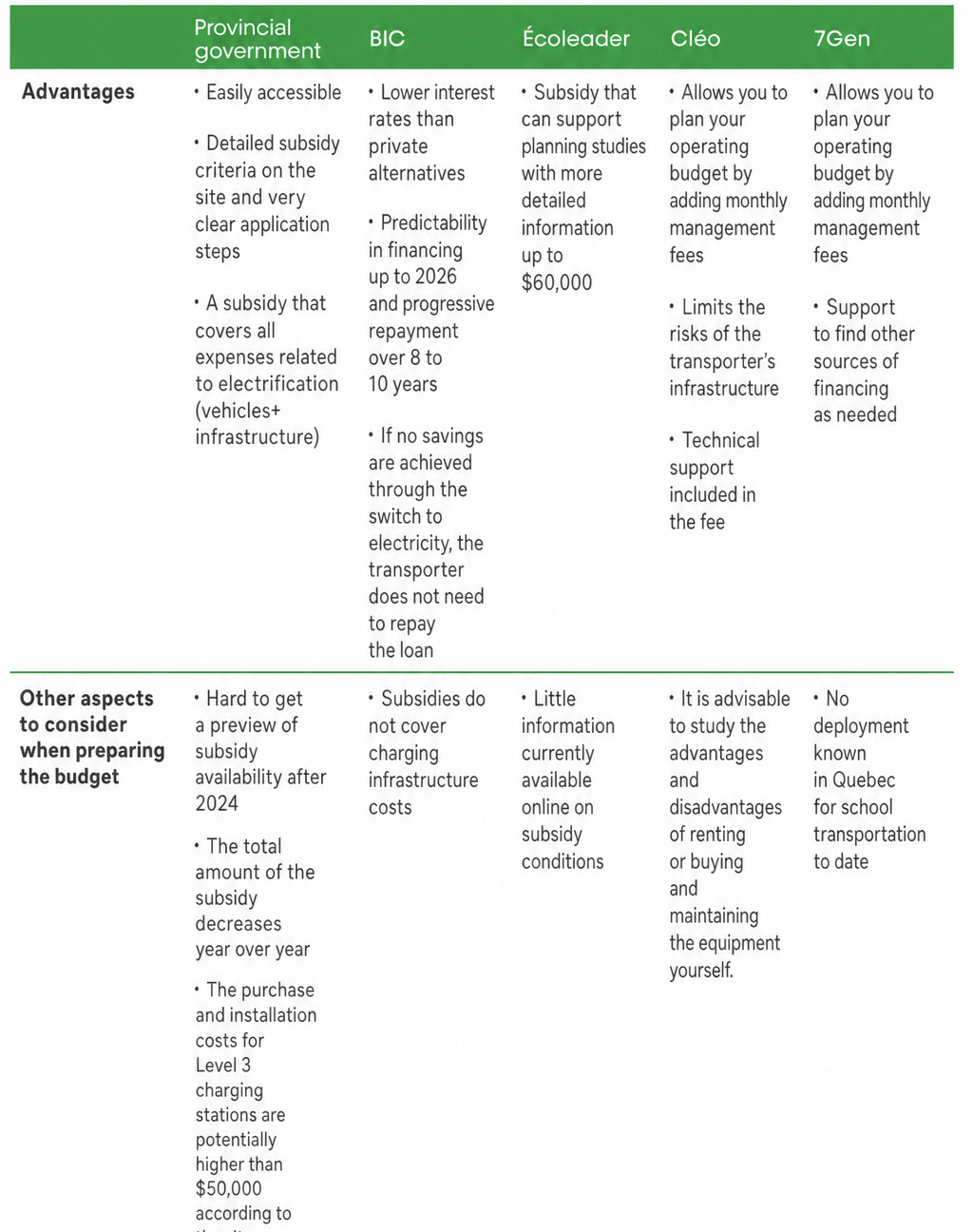
The table below presents a summary of the options discussed in this section, their advantages and the risks to consider.
In brief
When considering electrification, vehicles should be given as much importance as charging infrastructure, operations management software, and the conversion of buildings and maintenance workshops.
One guiding principle remains: you are not alone. All carriers in Quebec, large and small, have the opportunity to set an example across the province, in the regions, with families and future generations. In this sense, Propulsion Québec seeks to guide the ecosystem to help it shine and to accelerate the energy transition in transportation. We hope this guide has been useful in your reflections and will help you plan your next steps in electrification.


