


International recognition for the City of Calgary
The City of Calgary has stood out in recent years by promoting innovative solutions to optimize its vehicle fleet management while limiting its environmental impacts. We discussed sustainable strategies and future projects with Sharon Fleming, Fleet Director for the City of Calgary.
Can you describe your role?
I lead a team of 200 people who look after our roughly 1,000 heavy trucks, 1,600 light trucks and 1,300 powered pieces of equipment. Our mission is to ensure the safety, cost-effectiveness and availability of the municipal fleet, and to minimize its ecological footprint. It is through sound lifecycle management of the fleet’s vehicles, equipment and parts—which includes acquisition, maintenance and decommissioning—that the City can deliver services such as waste and recycling collection, road maintenance, potable water supply, etc. We also provide support to other City teams, whether in civil engineering, fabrication or safety.
As director, my role is to set the strategic direction necessary for the effective management of the City’s vehicle fleet. What particularly interests me is implementing innovative solutions: you must keep moving things forward by continually exploring new avenues.
Can you give some examples of practices or technologies the City of Calgary has adopted to reduce its greenhouse gas (GHG) emissions?
The municipal fleet alone accounts for 20% of the metropolis’s GHG emissions. As part of the City of Calgary’s Climate Resilience Strategy, we assess market-ready solutions and emerging technologies, such as electric vehicles, while keeping in mind the extreme weather conditions Calgary faces. We also work with various municipal departments to define their operational needs in order to right-size vehicles or implement a car-share system for underused units, when they are not simply being disposed of. Finally, we aim to favor the purchase of vehicles that are compatible with the City’s environmental objectives.
The City of Calgary has announced its intention to invest in a smart fleet program. What are the objectives and implications of such a program?
Our smart fleet program is based on adopting more eco-friendly and safer driving practices, implementing a car-share solution, optimizing the workflow management system and improving the quality and reliability of data. It is divided into three major projects:
- The Flex Fleet car-share pilot project aims to maximize the utilization of 10 to 25 vehicles by 2020;
- The e-Fleet virtualization project, developed using software functionality, seeks to eliminate paper-based manual procedures within maintenance operations;
- The Safe Fleet innovation project, for its part, aims to improve the fleet’s performance in terms of the environment, road safety and data integrity by implementing a governance model and optimizing existing technologies.
Earlier this year, at the Future Fleet Forum held in London, the City of Calgary was awarded the Future Fleet prize for the most innovative fleet management strategy. What does this award recognize and what does it mean for the City?
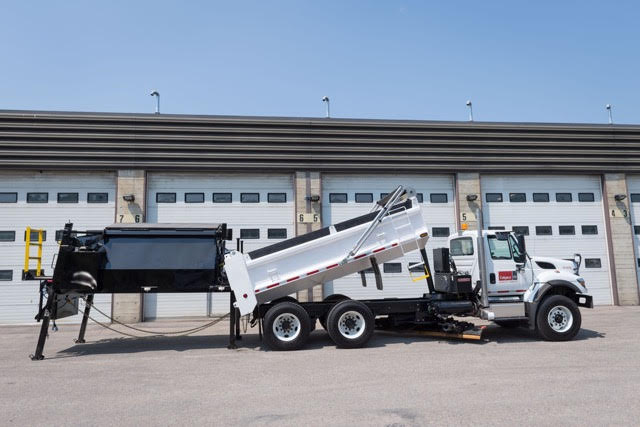
The Future Fleet awards recognize the outstanding contribution of municipal administrations as well as contractors and public sector individuals in the fields of safety, innovation and sustainable fleet management. The City of Calgary won the strategic innovation award for its patented slip-in asphalt conveyor-recycler system, designed in-house from a utility vehicle platform. This system is expected to save us millions of dollars in capital and operating costs, in addition to significantly reducing the tonnes of asphalt waste that end up in landfill.
Beyond the pride it gives us, this award validates years of work by our team, whether aimed at generating efficiency gains through the development of innovative solutions or reducing our operating costs. We have patented this system so that other municipal administrations can benefit from it as well.
What new strategies does the City of Calgary want to explore over the coming years to meet its environmental commitments?
We are currently conducting a study on alternative fuels, such as compressed natural gas and electricity, as well as a pilot project with heavy vehicles used for waste and recycling collection. We will analyze the evaluation results later this year and hope to launch the pilot in 2020. We are also reviewing our anti-idling policy and looking for ways to improve detection and reporting to change behaviour. Finally, we are working on the design of new prototypes. There is no shortage of interesting projects, and we have more in reserve. Follow us!


