


Sustainable and Safe Mobility: Spotlight on the City of New York
The City of New York manages the largest municipal vehicle fleet in the United States. From energy conversion to the implementation of Mayor Bill de Blasio’s Vision Zero, Keith Todd Kerman explains how the City has positioned itself as a leader in environmental practices and road safety.
Keith Todd Kerman is the Fleet Director for the City of New York and the Deputy Commissioner of the Department of Citywide Administrative Services (DCAS).
What role do you play in the sustainability efforts of New York's municipal vehicle fleet and in implementing the plan for the fleet announced in December 2015 by Mayor Bill de Blasio?
The fleet manages more than 31,000 vehicles, making it one of the largest in the world. We have over 2,000 full-time employees assigned to fleet and dispatch, in addition to our roughly 80,000 drivers. Under the Mayor's policy for a cleaner fleet, the City is committed to reducing its vehicles' greenhouse gas emissions by 50% by 2025. To that end, we are implementing one of the most comprehensive sustainability initiatives in the United States:
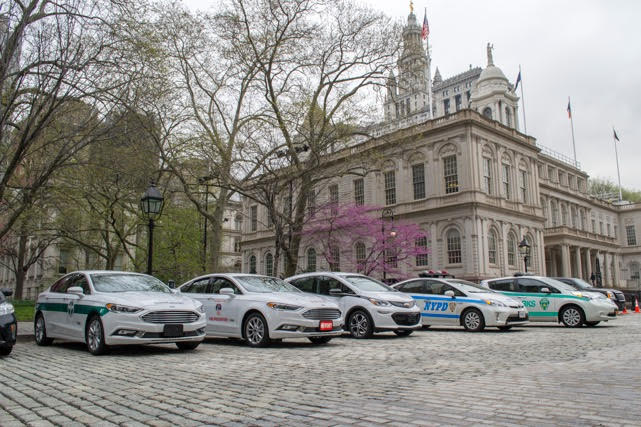
- We currently operate 1,800 electric vehicles and will increase that number to 2,100 by the summer. We already have electric sedans, crossovers, SUVs and vans, and we are on track to have electric buses, hybrid police cars and plug-in ambulances.
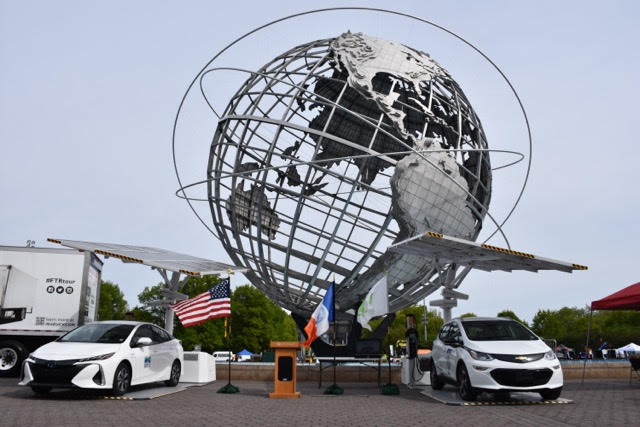
- For our growing number of electric vehicles, we operate 575 charging stations, including 60 mobile solar canopies. This equipment makes up the largest infrastructure of its kind in North America.
- New York is a pioneer in the use of biofuels in the United States, not only for its fleet but also for its municipal buildings. All our vehicles, including those of police and emergency services, run on biofuel blends. We are now working to add renewable diesel to the sustainable biofuels we use, with the goal of completely eliminating our consumption of fossil diesel.
- We operate more than 5,000 hybrid vehicles that run on natural gas and over 750 off-road electric and solar vehicles. By the end of 2019, more than 20,000 of our vehicles will be powered by clean energy.
- During fiscal 2018, our new light-duty utility vehicles achieved an average fuel economy of 100 miles per gallon, meeting the U.S. Environmental Protection Agency standard.
DCAS focuses its sustainability efforts on shared services. To that end, it has implemented, among other initiatives, the Fleet Share Program. Can you briefly explain the nature of this program and how it optimizes the fleet's capacity?
New York's fleet includes more than 60 operating agencies and offices. The main ones, which make up the Fleet Federation, are the police (NYPD), fire (FDNY), sanitation (DSNY), transportation (DOT), environmental protection (DEP), parks (Parks), corrections (DOC), health and mental hygiene (DHMH), taxis and limousines (TLC), emergency management (OEM), education (DOE), and administrative (DCAS) services.
Shared services is one of our priorities; our initiative to consolidate and share services is also one of the largest in the sector. Every day, agencies (NYPD, DSNY, Parks, DOT and DCAS) use and maintain vehicles for other agencies, helping to break down silos and reduce costs for everyone. For example, DCAS last year assisted in the maintenance of 1,000 vehicles for the NY Housing Authority.
In March 2019, the Mayor signed the Executive Order 41, which will further expand shared services, as well as the tracking of vehicle usage and cost-reduction efforts.
The order requires the fleet to reduce its vehicle count by 1,000 and its miles traveled by 10 million. We will use advanced telematics to track daily vehicle usage and will set a minimum utilization standard of 80% for the entire fleet. We will look for ways to decrease our vehicle use, for example by using the subway, reducing the number of trips, and changing routes to improve network efficiency.
In my view, our most promising initiative is our vehicle-sharing program. Various agencies share more than 750 of our vehicles through Zipcar technology. Employees have cards, not keys, and reserve vehicles online, as they would a conference room. This system will allow us to increase efficiency, reduce costs, and focus on transportation needs rather than assigning vehicles to employees.
Along those lines, DCAS has also put more than 60 Bolts into interagency sharing. These vehicles are now among the most used in the fleet. Many of them are, moreover, charged by our solar canopies.
All-electric shared vehicles, charged with solar energy—nothing better represents the fleet of tomorrow. And we have them today!
What is DCAS's role in achieving the Mayor’s Vision Zero? What concrete measures are being taken to improve the safety of the municipal fleet?
New York has become a leader in road safety thanks to the Mayor and his Vision Zero initiative. The fleet collaborates with the Vision Zero team, made up of members from the DOT, NYPD, TLC, DHMH, the Business Integrity Commission, and the Mayor's office.
The city's streets are safer than ever. We adopted Vision Zero after consulting our international partners, a vision that has become a national model. But we will not stop there: we want to do more.
Vision Zero has several components, namely road design, law enforcement, health monitoring, and fleet safety, a priority for DCAS and TLC. We are working to make our fleet the safest and most sustainable in the United States.
Here are some of our initiatives:
- To date we have trained more than 50,000 of our employees in Vision Zero and safe driving.
- We are adding telematics to all our vehicles so we can monitor speed, seatbelt use, driving habits and left turns in real time at our new control center.
- We are working with the Volpe Center of the Department of Transportation on the Safe Fleet Transition Plan to ensure that the specifications and design of our 160 vehicle models provide the highest possible level of safety.
- We are pioneers in North America in adding side guards to our trucks and recently announced that we will switch to high-visibility trucks. These initiatives stem from international partnerships.
- We encourage our sector to distinguish between safety and luxury in vehicle sales and marketing.
- We prohibit the use of hands-free phones by our drivers: distraction kills.
- We are working with the New York DOT, with support from the U.S. DOT, on integrating vehicle-to-vehicle and vehicle-to-infrastructure technology.
We believe system design is as essential to road safety as road design. With vehicle-to-vehicle and vehicle-to-infrastructure technology, our vehicles and systems communicate better, which has the potential to greatly improve long-term safety. Cars that talk to each other. Infrastructure that talks to cars. The goal? Prevent collisions in real time and protect the safety of drivers, cyclists, and pedestrians.
These efforts are not in vain. The number of deaths and collisions per mile is falling sharply. But we still have a lot of work to do.
What projects and innovative ideas can be expected from DCAS in the coming years?
We recently created the Fleet Office of Real Time Tracking, FORT. From City Hall, this office acts somewhat like a control tower, monitoring fleet activities. This initiative will help us improve safety, reduce the number of collisions and respond to them, better measure fuel savings, study fleet utilization, and much more.
FORT will also serve as a common tool for our 60 client offices that provide direct services to the public and will help the City manage major emergencies. After several years of preparation, it is finally operational and will help us over the coming years to rethink the use and maintenance of our vehicles.


