


Recognizing the importance of maintaining Canada and Quebec's lead in the transport electrification sector while ensuring our commitment to reducing GHGs under the Paris Agreement, the Government of Quebec offersfinancial assistance that can exceed $100,000 for the implementation of a fleet electrification project. However, companies must contribute at least 50% of the total investment and often the required amount exceeds the financing limits authorized by the government. So, how do you identify the best candidate vehicles for migration? How can you ensure that the CAPEX will yield a good return on investment and not jeopardize the organization’s financial health? The answer is certainly business intelligence through Big Data.
Last September, during the Impulsion MTL event, analysis of the data collected by telematics systems was at the center of attention. The keen interest generated by the topic confirms that the shift is imperative and that the future is much closer than one might imagine. We must begin preparing now to ensure a sustainable and competitive future. The challenges are many: workforce training, the capacity of electricity grids, the wait to obtain an electric truck or bus, to name a few.
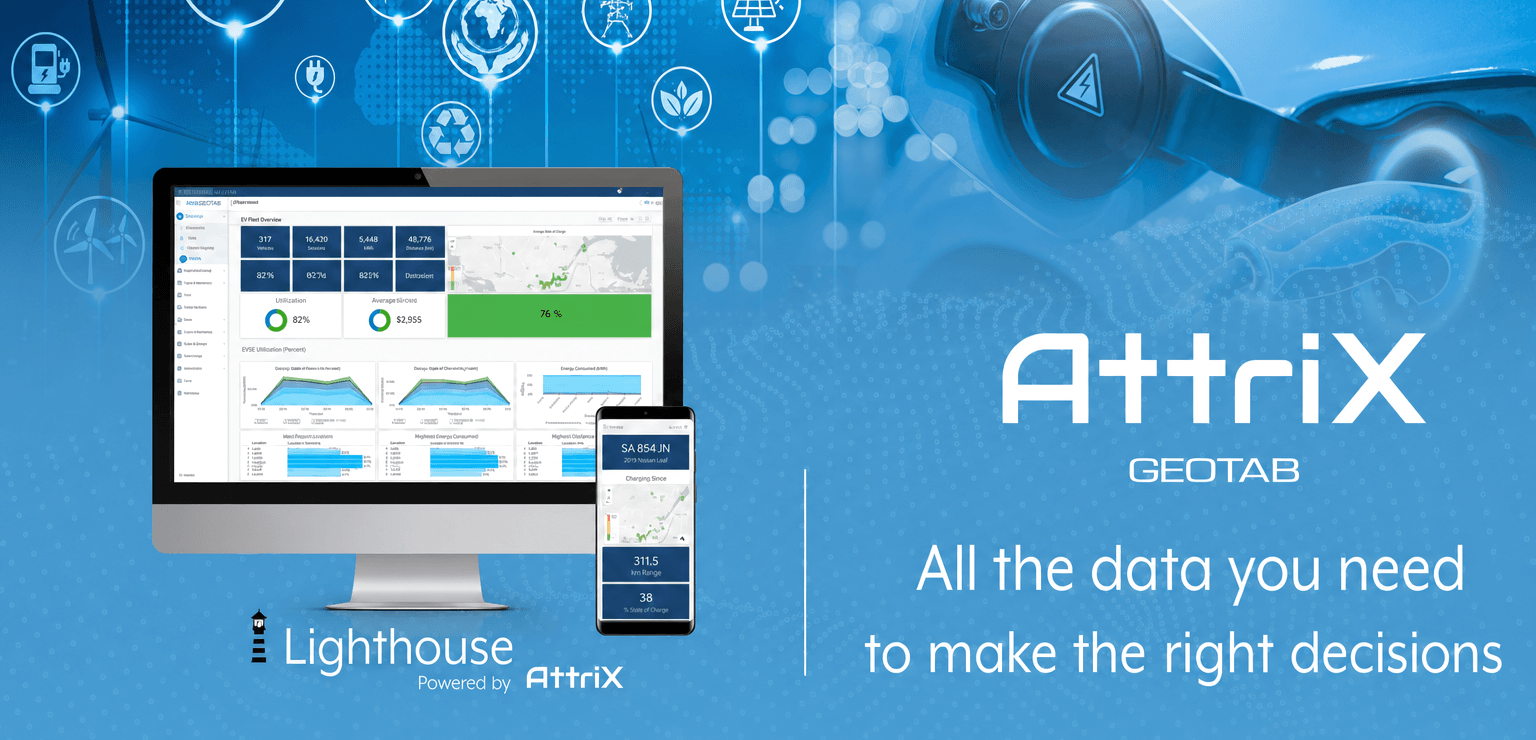
In this rather complex context, AttriX, a leader in telematics and big data in the transport sector in Quebec and a major player in the electrification of commercial fleets, has launched its Lighthouse platform. This new solution aims to automate the identification of internal combustion vehicles that meet the criteria for conversion to an electric equivalent, display summary opportunities in financial gains and GHG reductions to encourage a manager to take action. Furthermore, the platform simplifies analysis and decision-making regarding vehicle electrification by relying on the analysis of data collected upstream of major investments such as power and infrastructure needs according to routes and equipment. “To ensure that the energy transition represents an opportunity and not a burden for transport companies, the manager must plan and implement a transition strategy based on real and easily understandable information about their own fleet. Our solution allows evaluating each vehicle at an unparalleled level of detail. Thus, they can determine the routes, driving trends and candidates that will deliver the best performance to replace an internal combustion vehicle with an electric model,”explains Anthony Mainville, president of AttriX.
Designed with the support of major technology players such as Google for infrastructure and Geotab, which allows us to access the richest aggregated vehicle data bank in the industry, this solution ensures comparable analyses, a surprising volume of critical information and impeccable security to meet companies' needs for the first step of migration: planning. The benefits of this tool also extend to companies taking their first steps toward a greener operation since pre-transition thermal consumption measurements can improve driving habits and optimize fuel use for vehicles not yet eligible for migration. With better performance, companies achieve reduced operating costs and GHG emissions at the same time.
Moreover, the challenges do not stop there since electric vehicles generate telematics and instrumentation data different from those of conventional vehicles. “That is why, for a long time, we have worked closely with OEMs. Our understanding of EVs is unique in the market. After deploying one of our solutions on a fully or partially electric fleet, managers can access energy consumption reports. Whether for a light vehicle, a heavy vehicle or a bus, it is therefore possible to set a realistic GHG reduction target based on the fleet's history and to monitor progress. They can receive battery level notifications to indicate the imminent need for a recharge, prioritize the fleet's charging order, centralize and simplify the vehicle safety inspection round (RDS), not to mention the traceability that may be required by the industry. Last but not least, companies can rely on AttriX's support service, known for its agility, efficiency and friendliness. This includes numerous free or a la carte training sessions to improve compliance and smooth business operations,”adds Anthony.
Once eligible vehicles have been identified, it is necessary to assess other critical data: energy demand and electricity availability at the charging site. For example, a Class 6 truck for last-mile deliveries, with a range of 340 km, will need a Level 3 charger, preferably with a power between 250 and 350 kW for a fast recharge (minimum 2 hours). Infrastructure work must be carefully estimated and depends on the availability of the local energy supplier.
During his address at the international climate summit organized by the U.S. government in May 2021, Prime Minister Justin Trudeau explained that the carbon price will reach $170 per tonne by 2030. If the transport industry hopes to effectively contribute to achieving the objective of reducing GHG emissions by 40 to 45% by the end of that period (compared to 2005 levels), companies that wish to benefit from a positive image and solid financial results must act today. Tomorrow will be too late.
For more information, please contact Luciana Coura at 514-247-2958 or by email at lcoura@attrix.ca.
This sponsored content was produced as part of the Impulsion MTL 2021 event – The international forum on fleet management.


