


Nearly 18 months after the official launch of the Colibri ecological urban delivery pilot project, the verdict is unanimous: it is a resounding success.
The operational performance is so conclusive that the model is planned to be replicated in other boroughs.
Compelling results
From the start, the integration of cargo bikes into the urban landscape went smoothly and the reception from the public and the media was very positive. A year and a half later, the Colibri Project completed more than 130,000 decarbonized deliveries between September 2019 and December 2020, reaching a weekly average of 5,000 deliveries for the 2020 holiday period.
On an annual basis, it is therefore estimated that the Colibri project helped avoid 80 tonnes of CO2 emissions, 130,000 km of truck travel and 16,000 hours of truck presence in downtown Montreal.
Statistically, this pilot project demonstrated that cargo bikes are more efficient than traditional delivery trucks in dense environments, making nearly 15% more stops per hour.
Moreover, they use less space on the public roadway, freeing up a significant amount of space for other functions. Taking into account the smaller footprint of the cargo bike relative to the truck as well as shorter average stop times, the Colibri delivery mode uses five times less space than the traditional delivery mode.
Two new mini-hubs announced
Faced with such success, the City of Montreal has announced in February that the Colibri model would be reproduced with two new logistics mini-hubs in other boroughs. Led by Coop Carbone, these mini-hubs aim to sustain the model in the metropolis.
An innovative delivery model
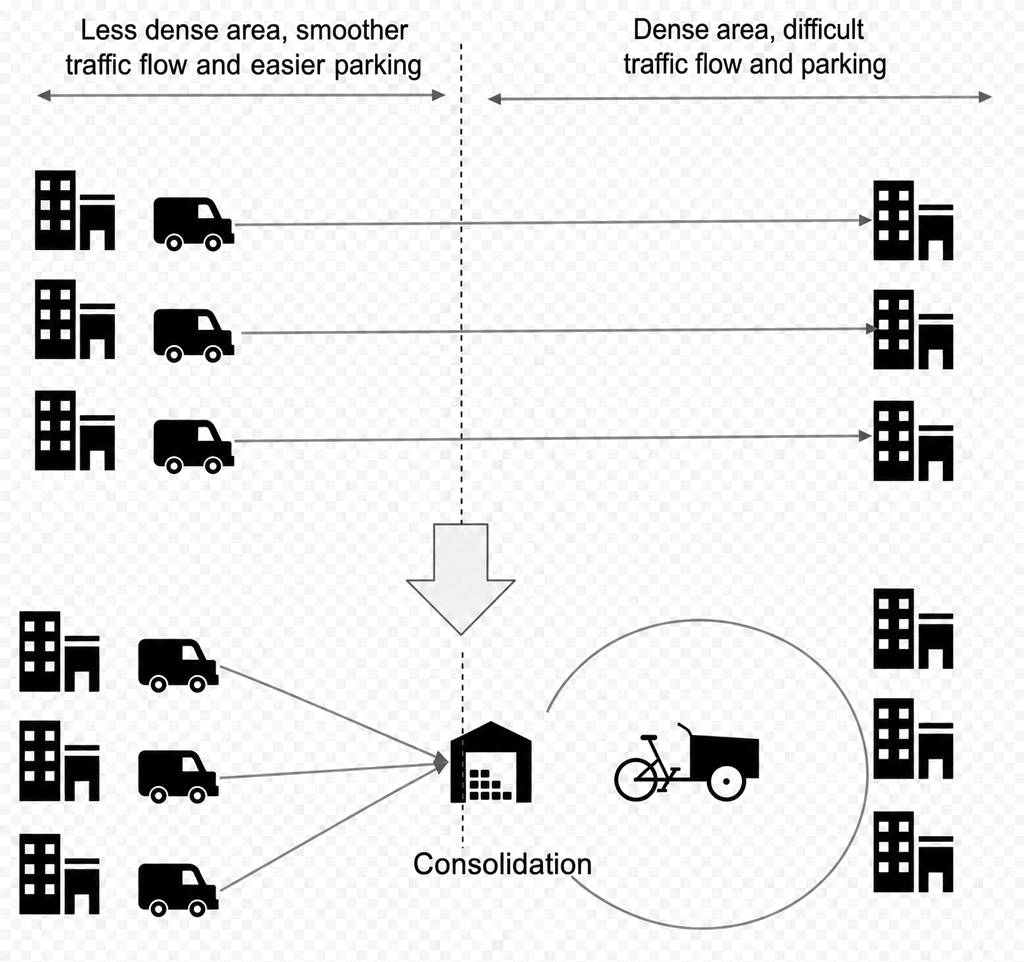
This initiative, implemented in September 2019 in collaboration with Jalon MTL, is part of an effort to find sustainable and intelligent mobility solutions. It was the first accomplishment of an urban logistics experimentation hub within the City, which aimed to test eco-friendly freight transport solutions.
The main objectives of the initiative were to evaluate the operational performance of the practice combining an urban logistics mini-hub with cargo bikes by comparing it to a conventional mode that involves dispatching delivery trucks from sorting centers located far from downtown, and to estimate the broader economic and environmental performance of the model.
PHOTO CREDITS: copyright City of Montreal / Mathieu Sparks.
This sponsored content was produced as part of the Impulsion MTL 2020 event – The international forum on fleet management.


