


One of our membersCalogy Solutions, a young company focused on creating sustainable thermal management solutions in the field of electric transportation, normally uses the shared laboratories of the Interdisciplinary Institute for Technological Innovation (3IT) at the University of Sherbrooke for its experimental work.
Following the guidelines issued by public health in March to address the Covid-19 pandemic, the team atCalogy Solutionsanticipated the possibility of no longer being able to access such facilities, which would be inaccessible during this exceptional period. It was then that three employees of the company — Mehdi Hedhili, Samuel Fillion and Nicolas Voeltzel, some of whom had just started — proposed a very innovative approach. Showing great passion, adaptability and creativity, they set out to relocate the company's various activities to their homes, including a temporary laboratory in one of their garages. Remote-work innovation never ceases to surprise us!
What does a lab in a garage look like?
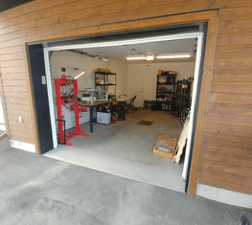
The three colleagues managed to move the necessary equipment in time before the shared laboratories were closed, and it has since been housed in Samuel’s garage. This “home” lab made it possible to perform preliminary tests to evaluate their prototypes. They arranged their space to accommodate, among other things, a thermal bath, heating elements, a data acquisition system for temperature, voltage and current, as well as a brand-new hydraulic press they had just acquired. All these tools enabled materials characterization, testing both insulating materials and highly conductive materials. They were thus able to conduct in-depth analysis of their results and validate valuable data.
They used the same approach to create other “departments” at their homes. Nicolas’s apartment thus became a computing center thanks to the installation of a high-performance server that the whole team can now connect to remotely to run engineering simulations. Mehdi’s apartment also became a temporary warehouse and allowed them to provide quality assurance. He was thus able to receive and validate, in his kitchen, the parts and components designed by team members and those coming from suppliers.
Of course, they took care to follow all health and safety guidelines by maintaining social distancing and disinfecting surfaces after use. Fortunately, the results of these experiments were conclusive and even allowed them to meet the ambitious deadlines they had set for this project before the lockdown.
Other positive effects also emerged during this innovative process, such as the great resourcefulness they had to show and the spirit of camaraderie that quickly developed when launching this unusual project. They now hope that the “COVID garage” will live on beyond the pandemic, allowing them to continue limiting interactions in order to help curb the spread of the virus.
We wish them as much success as those other well-known companies that also started in a garage!


