


/ PUBLIC TRANSIT / ELECTRIC VEHICLES / CHARGING INFRASTRUCTURE /
Support the commissioning of electric school buses with a tailored charging offering.
A PROJECT BY


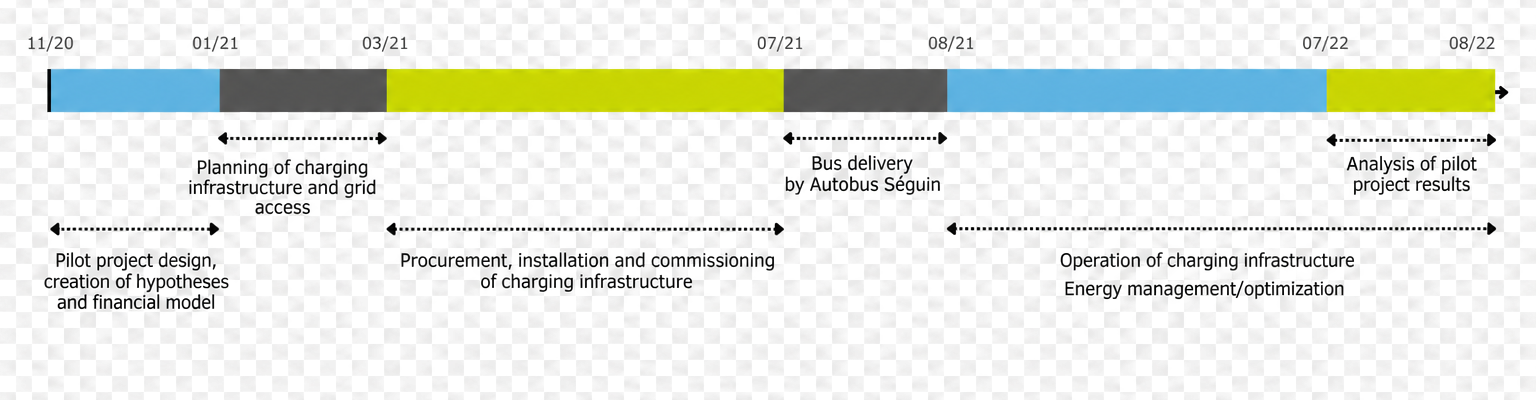
To facilitate and support the electrification of commercial vehicles, Hydro-Québec initiated, in August 2021, a pilot project with Autobus Groupe Séguin, a Quebec family-owned company operating in school and charter transportation, which ordered 60 electric school buses at the beginning of 2021.
This pilot project includes the installation of 12 charging stations with a total power of 260 kW to support the commissioning of the first ten electric school buses for the September 2021 school start. The pilot runs over one year and allows verification of certain parameters related to the operation and charging of electric buses.
Following the success of the pilot project, the charging offering for vehicle fleets is commercialized by a Hydro-Québec subsidiary: Cléo.
Cléo, a Hydro-Québec subsidiary, offers the full range of services necessary to implement a robust and effective charging infrastructure, as well as an intelligent charging platform, for light, medium, or heavy commercial vehicle fleets.
Cléo’s service provides full support for the deployment of the charging infrastructure, including its design, selection and purchase of chargers, installation, commissioning and maintenance of equipment, as well as dynamic daily charging management through its intelligent platform.
Cléo’s intelligent charging management platform is designed to automate vehicle charging reliably and resiliently. It controls the chargers and dynamically adapts to unexpected events, to maximize vehicle availability while minimizing the electricity bill.
Project objectives
- Understand the business context of school transport operators, their needs, and the technological solutions available for electrifying their fleets ;
- Specify the parameters for operationalizing such a charging service.
Test criteria
- Analysis of vehicle usage cycles (schedules, distance travelled, etc.) ;
- Evaluation of the compatibility of the technologies considered ;
- Sizing and design of the charging infrastructure ;
- Validation of charging reliability ;
- Optimization of energy management ;
- Level of support required from the operator.
Target users of the solution
The pilot project was carried out for school transportation, but the knowledge gained allowed Cléo to offer solutions to all types of operators of light, medium, or heavy commercial vehicle fleets.
Partnerships established
Development of links with stakeholders in the TÉI ecosystem.
Together, let's support and accelerate innovation by sharing knowledge and best practices!
Pre-project methodology
Funding
The pilot project required a budget of approximately $585k, with infrastructure and electricity costs borne by Autobus Séguin. A grant of $432k was awarded by the school transport electrification program. Costs related to research and development, engineering and consulting services, as well as project management, were borne by Cléo.
Results achieved
In its first version, the PETS financial assistance program excluded leased services. It was later modified to include this option.
CHALLENGE
Reliability of EV charging while minimizing power draws in order to reduce operators' electricity bills and the impact of demand on Hydro-Québec's network.
solution
The development of Cléo's intelligent charging management platform to support operators.
CHALLENGE
Long connection delays to Hydro-Québec's grid.
solution
Submit a connection request at the start of the project.
CHALLENGE
Low maturity of technologies (chargers and vehicles) which leads to operational challenges.
solution
Deployment of chargers from more than one manufacturer to reduce risk.
The project's outcomes enabled the following gains:
- Validation of the business model, optimization of infrastructure designs, calibration of the intelligent charging management platform ;
- development of Cléo's intelligent charging management platform ;
- Signing of a commercial agreement with Autobus Groupe Séguin and other operators within the year following the pilot project ;
- Validation of the cost structure of an electrification project.
Lessons learned
Success factors
- Conducting market studies to understand the barriers to electrifying commercial vehicle fleets and the potential for EV adoption in Quebec ;
- Collaboration with the Federation of Bus Carriers (FTA) to understand the operational challenges of its members ;
- Collaboration with government bodies on the development of financial assistance programs for fleet electrification.
Practical advice for carrying out such a project
- Plan your electrification well by giving yourself enough time to submit connection requests to Hydro-Québec's grid and to procure equipment.
- Do not underestimate the human resources needed for operating and operationalizing charging.
- Have a good internal change management plan.
- Provide training for employees. Do not hesitate to seek external support and expertise to reduce project risks.
- Start early by implementing good energy-efficiency practices, such as an intelligent charging management platform, to avoid costly electricity bills.
- To ensure the successful transition of fleet operators and in the interest of the industry, we firmly believe it is essential that all stakeholders work together to ensure interoperability of equipment and systems. TÉI technologies are booming and constantly evolving, and it is by collaborating that we will be able to accelerate the electrification of Quebec's transportation.
Next steps
- Development and commercialization of Cléo's multi-segment charging service offerings
- Contribute to operator education to ensure the success of their energy transition
- Develop partnerships with various stakeholders in the TÉI ecosystem to accelerate the electrification of commercial vehicle fleets in Quebec
- Adjustment of subsidy programs, for segments other than school transportation, so that operators are not the only ones eligible for subsidies.
- Adjustment of subsidy programs to better match the size of projects for commercial vehicle fleets
- In a context where the purchase cost of EVs remains high, it would be desirable that subsidy programs are not scaled back immediately
- Incentives to vehicle manufacturers for deliveries of EVs to Quebec.
- Support for training a specialized workforce and dissemination of promotional campaigns to attract new talent to the TÉI ecosystem
Following the pilot project, Cléo continued its activities and acquired clients in school transportation as well as in other market segments.
Turnkey service
- Autobus Groupe Séguin, Laval (2nd site) – school transportation
- Groupe Autocar Jeannois, Alma – school transportation
- Transport Therrien, Fermont – passenger transport
- Transport Simard, Lachine – freight transport
- Coop Carbone, Montreal – last-mile delivery
Intelligent platform
- Transco, Montreal – school transportation
- Vidéotron, Montreal – public service
Project partners
Project contact person
Cléo
Sylvain Cabanetos
Account manager
sylvain.cabanetos@cleo.eco
Autobus Groupe Séguin
Stéphane Boisvert
President
sboisvert@autobusseguin.com
Do you have a project in the experimentation phase?
Propulsion Québec is conducting a series of interviews aimed at extracting the lessons learned from a series of experimental projects that took place in recent years in Quebec...
Help make Quebec a world reference in experimentation and accelerate the development of the TEI sector by sharing the lessons to be learned from the experimental projects you have conducted. Your project could be the subject of a fact sheet produced by Propulsion Québec and shared with the entire TEI ecosystem.
Submit my project


