


Intelligence and autonomy in transportation is a story that began nearly half a century ago. Thus, in the early 1980s, avionics systems began replacing more traditional mechanical and hydraulic systems through onboard computers and software. Faced with this challenge, various standards were created to ensure the functional safety of these embedded systems, notably the DO-178 standard, which has since evolved twice to address the increasing complexity of newer software.
Since then, we have witnessed a true revolution in advanced driver assistance systems (ADAS) for more than a decade. Various intelligent systems such as steering assistance, emergency braking, cruise control, parking assistance… have become widespread and are now offered in mid-range cars. The advent of these intelligent systems also gave rise to a standard to guarantee their functional safety: ISO-26262. It turns out that the majority of the people who contributed to the development of this standard were also involved in the aviation standard DO-178 (version B), which shows the convergence of these two industries.
CS Group has precisely developed validation and certification processes and strategies based on twenty years of experience in certifying avionics systems, so-called “post-failure operational processes,” processes and strategies that today prove effective in accelerating the certification of embedded systems for road vehicles.
By building on ADAS systems, we have seen massive investments in autonomous driving systems for several years now, notably in sensors, which will be the key to commercializing autonomous vehicles.
To that end, the Quebec company LeddarTech develops unique sensors based on its patented technology, as well as components enabling OEMs to integrate LeddarTech technology into LiDAR solutions optimized for their clients’ different needs. The company, known for its LiDAR technology, has also expanded its offering since theacquisition in 2020 of the Israeli company VayaVision by offering perception and sensor data fusion solutions that work with all detection modalities present on autonomous vehicles.
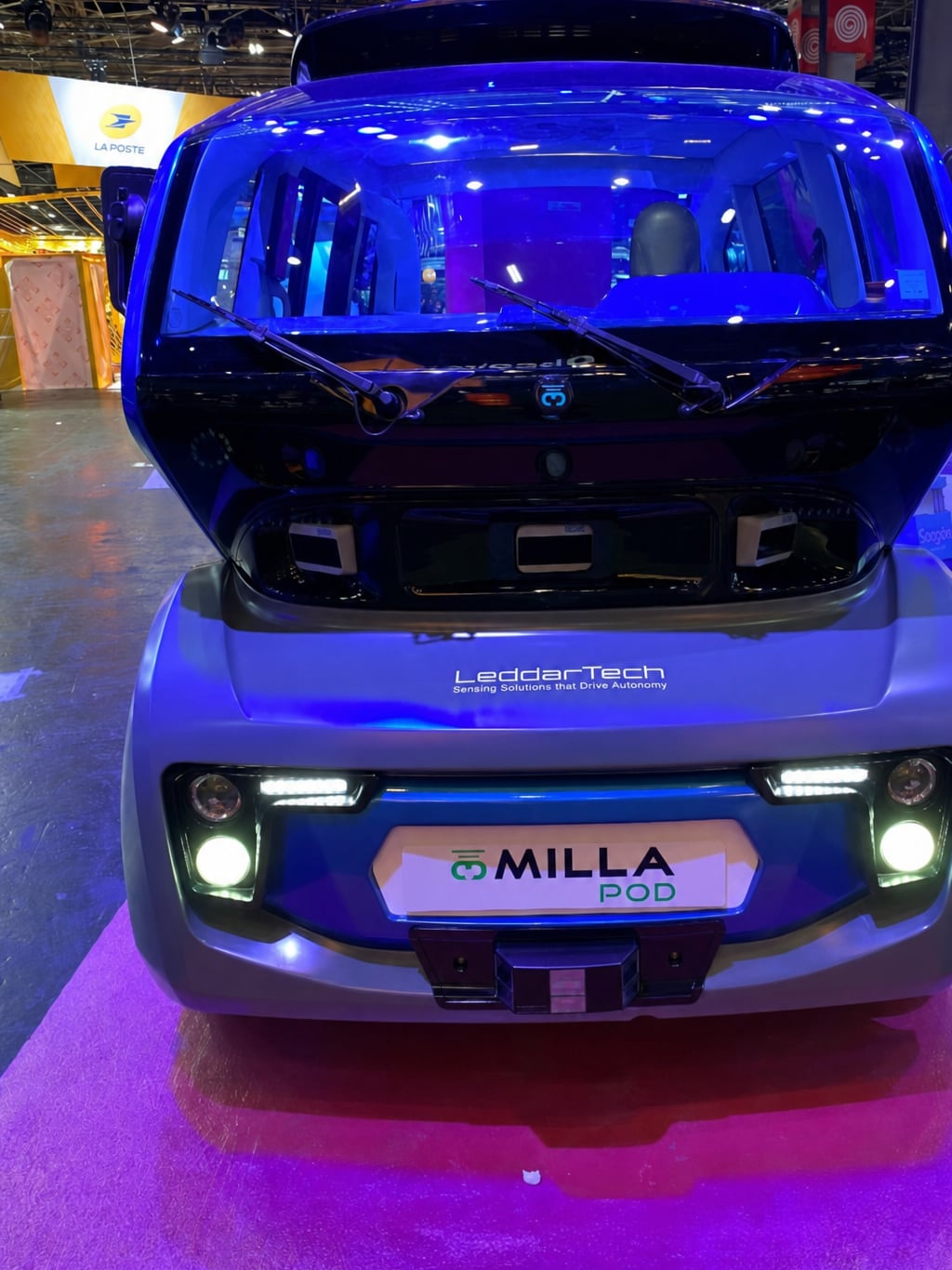
Its CTO, Pierre Olivier, presents some elements in this article that demonstrate the importance of LiDARs and AI in the commercialization and functional safety of autonomous vehicles.
Amine Smires, Director of New Programs and Innovation at CS Group Canada : Why do LiDARs improve the functional safety of road vehicles? What do they bring beyond the historical sensors such as cameras or radars?
Pierre Olivier : LiDAR helps on several levels. First, LiDAR provides a direct depth measurement, which can resolve certain failure modes specific to cameras, for example in the case of an image of a pedestrian on the rear door of a truck that could be mistaken for a real person. Compared to radar, which also provides depth measurement, LiDAR offers better resolution.
By adding this richer information, various perception tasks (object classification, free-space detection, etc.) become simpler and can therefore require less processing or less training to reach the same level of performance. This translates into lower cost, better performance, or a shorter development cycle.
Also, LiDAR provides better system robustness, since its failure modes are different from those mentioned earlier for other sensors. For example, radar has difficulty handling certain situations (inside a tunnel, notably) that LiDAR manages correctly. In terms of functional safety, this therefore reduces “common-mode failures” and helps achieve safety objectives.
Amine Smires : In which SAE J3061 levels of automation is LeddarTech involved today? Do you plan to go up to level 5?
Pierre Olivier : LeddarTech’s solutions cover all levels of automation. Obviously, in the long term, the level 5 market is attractive. However, ADAS systems are currently being deployed increasingly and still present challenges that become more acute with the evolution of standards like the GSR in Europe, which LeddarTech’s solutions help address.
Amine Smires : There are certain markets in controlled environments such as forestry, mining, construction or even shuttles, where level 4 autonomous vehicles are already seen. Can you tell us about LeddarTech’s involvement in these verticals?
Pierre Olivier : LeddarTech is actively pursuing these markets. Without revealing all ongoing projects, some recent announcements notably reference our collaboration with Trimble targeting off‑road applications, the one with MILLA for shuttles, and the one with Westfield for autonomous street sweepers.
Amine Smires : What is the biggest challenge to having LiDARs on safety-critical systems? Is certification of artificial intelligence (AI) one of them?
Pierre Olivier : Artificial intelligence is unavoidable; it is the complexity of the application and the diversity of scenarios that require it, not the use of LiDAR. Today, all level 3 and above solutions use AI for tasks such as obstacle classification, for example.
We should also demystify the use of artificial intelligence. Obviously, the result of the training process depends primarily on the input data, and therefore the construction of training, validation and test datasets must be an integral part of the development process. In contrast, the inference process carried out in the vehicle once the networks are trained is extremely predictable and repeatable; simplistically, it’s like combinational logic, and the same input data should always generate the same results. In short, training is what is critical for the safety of the final product and, again, this is specific to the application, not to the type of sensor used.
As the advent of L3 systems is imminent and we anticipate more than 2 billion lines of code for a fully autonomous car (a complete airplane contains less than 10 million), the certification of these complex embedded software systems endowed with artificial intelligence will be one of the keys to commercializing autonomous vehicles. In this technological trajectory leading us to L4/L5 systems, the technological advances of ADAS systems (L1/L2) are notable.
Thus, thanks to the ISO 26262 and SOTIF standards, our mission at CS Group is to guarantee their safety. For this, the expertise built by CS Group in avionics systems is an asset that accelerates the certification of ADAS systems.


