


/ DENSE URBAN / INTELLIGENT VEHICLES /
Develop learning about the behavior of autonomous shuttles within a very dense, residential urban environment.
A PROJECT OF



The shuttle project led by the City of Montreal on the Plaza St-Hubert site aims to experiment with an automated collective transportation solution in order to prepare the City and anticipate a true technological revolution in this sector.
Project objectives
- Evaluate and test the technical capabilities of autonomous vehicles in a dense urban environment, namely along the Plaza St-Hubert corridor in Montreal
- Acquire valuable knowledge to establish the broad guidelines for the use of this type of vehicle in the future (notably regarding regulations and inherent insurance rules)
- Raise awareness and inform the public to increase public knowledge on the subject
- Study the sociological effects
- Develop implementation skills for new modes of transportation
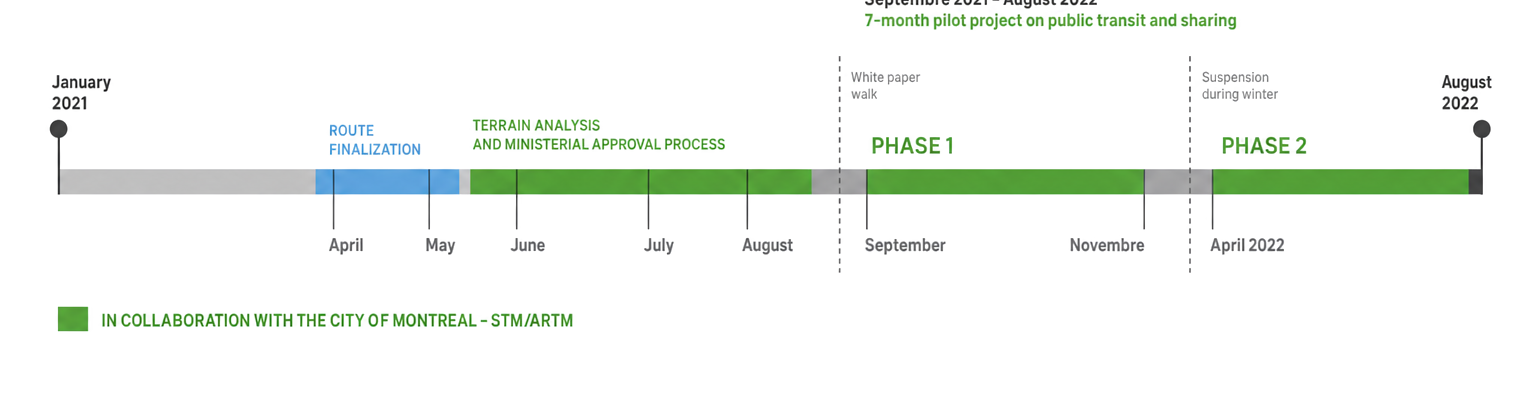
The shuttles were in operation for about five months in total in 2021 and 2022. The entire process took place over a 10-month period, after a pause due to COVID-19.
This service, offered free of charge to users, also aims to facilitate movement on Plaza St-Hubert, particularly for people with reduced mobility. Each shuttle could accommodate 15 passengers. Note that pandemic-related rules and those specific to safety limited the vehicle capacity to the number of designated seated places with seat belts.
A two-phase project
- The first technical phase aims at shakedown, validation of shuttle operation, and mastery of the site (configuration, traffic, behavior of local residents, etc.).
Six-week period: mid-October to mid-December 2021 - The second phase aims to increase ridership or traffic. Shuttle schedules are also better adapted to the needs of businesses and the neighborhood's dynamism.
Period: July 27 to September 1, 2022.
Together, let's support and accelerate innovation by sharing knowledge and best practices!
Pre-project methodology
Before putting the shuttles into service, the team conducted feasibility studies to identify suitable sites for the use of autonomous shuttles. The goal was to identify the sites best suited to host autonomous vehicles, based on the needs and particularities of the territory.
For example, it ensured that the route was precisely defined to fully understand the challenges from the start as well as the added value of such a service. Several other elements, such as the availability of parking for the shuttles, access to electricity for charging, tree pruning (branches and leaves that are too low can disrupt the proper functioning of sensors), and road surface quality, must also be considered upstream.
The Ministry of Transport and the SAAQ ensured the road safety of users at all times. A technical committee composed of road safety experts from the two entities, among other things, carried out the technical validation and monitored the process in compliance with current regulations. Once the vehicles were deemed fit for experimentation, a ministerial decree was approved by the Minister of Transport, thereby granting the required authorization to proceed with the project.
Funding
Investments of $1.3M were required for the shuttle rental, programming-configuration, maintenance, training of on-board operators, and site development works. The project benefited from a grant awarded by theMinistry of Municipal Affairs and Housing (MAMH).
Results obtained following phase 1
Speed limit
Observations by road users on site revealed speeds of around 35 km/h, even 40 km/h on certain segments of St-Hubert Street, although the maximum speed is 20 km/h. The maximum speed reached by the shuttles is 17.94 km/h, representing a high differential of around 17 km/h or 22 km/h between them and other road users. The goal of an autonomous shuttle is not to act as a speed attenuator. This is not necessarily an advantage, but rather a risk, due to the speed disparity between the shuttle and other road users using the roadway.
Relatively well-automated route
Data from the piloting report in autonomous mode versus manual mode indicate that 89–90% of shuttle piloting was carried out without operator intervention. Manual takeovers are mainly due to double-parked vehicles or vehicles encroaching on the roadway exactly where the shuttle must pass. The speed disparity between the shuttle and other road users traveling at high speed can therefore constitute a risk. Although the aim of an autonomous shuttle is not to function as a speed attenuator, in this case it is a value added.
Connectivity to infrastructure
Four of the eight intersections crossed by the shuttles are equipped with traffic signal control infrastructure that communicates with the onboard system of the shuttle so that it can safely pass through each intersection. Two problems appear to have been identified and solutions are planned to be deployed during phase 2 so that the project can continue.
Sensor sensitivity
Lidars allow the vehicle to detect objects in its environment, but do not give it the ability to distinguish between different types of objects. Unable to differentiate a human from an inanimate object, the shuttles adopt the same precautionary behavior of coming to a stop. In cases of unexpected or sudden obstacles, braking can occur abruptly and unexpectedly.
Level of autonomy and environment management
The level of autonomy of the shuttles allows them to be used in a busy urban environment. This environment must be adapted to the shuttles' limitations. Therefore, a good-quality roadway, appropriate road markings and signage, a predictable environment, and an alert operator must be provided.
Lessons learned
Success factors
Importance of favoring a constructive, collaboration-focused approach within the team.
Among other success factors are:
- Conducting a structured feasibility study during the preparatory phase;
- Validation by the Ministry of Transport and the SAAQ;
- Conducting tests to validate the technologies;
- Consistency and stability of the team;
- The expertise of resources dedicated to the project; level of knowledge of the technologies;
- Transparency and information sharing by all members of the project team (including the operator and the manufacturer);
- Speed of responses or the responsiveness of stakeholders;
- Precise definition of the route to fully understand the challenges from the outset;
- Connectivity and complementarity with other modes of transport, such as the metro and buses;
- Planning certain key elements, such as the availability of parking for the shuttles, tree pruning, and upstream route preparation, etc.
- Two-phase project, allowing tracking of the successes and challenges of the first phase. This feedback made it possible to adapt the route (among other things) for subsequent phases;
- The involvement of Plaza St-Hubert stakeholders.
Practical advice for carrying out such a project
- Ensure proper planning of funding (public and private) in advance;
- Validate the safety and feasibility of the selected route at least six months in advance for a project whose shuttle capabilities are known. Note that this timeframe could vary with new types of vehicles;
- Manage approval requests proactively to avoid delays;
- Map the 3D environment accurately. The environment and built environment may have changed between the study and vehicle deployment;
- Prepare operational implementation in advance: tree pruning, road markings, updating traffic lights (if necessary), etc.
- Provide a coordination mechanism between the teams involved, especially if they are located in different cities or countries (Navya in Detroit and Keolis in Paris for the Plaza St-Hubert project);
- Anticipate recruitment challenges for drivers (class 4B) whose presence is legally required in order to be able to regain manual control of the vehicle if the situation requires;
- Anticipate route demand (illegal parking, driver incivility, dangerous behaviors, parcel delivery volume, etc.);
- Integrate traffic light synchronization.
Things to keep in mind when conducting a similar project
- Clearly understand the vehicle's technical capabilities and limitations;
- Verify whether the level of experimentation, maturity, and performance of the vehicle is adequate (for example, speed in dense traffic zones, comfort, braking, etc.);
- Present the project proactively to citizens and merchants to explain the advantages and challenges of this mode of transport and establish a link that fosters continuous communication;
- Inform the MTQ and the SAAQ of mechanical developments of the vehicle for learning purposes.
Next steps
Lessons learned and best practices will be integrated into the City's next Urban Planning and Mobility Plan 2050. The findings will help inform reflections regarding autonomous and shared mobility. More autonomous shuttles would in particular make it possible to better discover the potential and limits of these vehicles.
The success factors of the current project rely on adapting the shuttle's physical environment and continuous monitoring by the operator.
The memorandum of understanding between theCity of Montreal and the Ministry of Municipal Affairs and Housing (MAMH) governing studies and experiments on Autonomous Vehicles is valid until 2022. It may be extended until 2025. A decision to that effect will be made by the government.
The demonstration of the concept relies on conducting other experimental projects of autonomous buses and minibuses. Reflection regarding the future of this type of vehicle in Quebec will need to be considered.
Project partners
- City of Montreal
- Keolis – Shuttle operator responsible for the service
- Navya – Shuttle manufacturer, responsible for shuttle programming and maintenance
- Ministry of Transport of Quebec and SAAQ – Technical committee responsible for approving the route as well as evaluating and monitoring the experimental project to ensure its safety
- STM – Observer partner
- Montreal City Police and Fire Services
- Sustainable Mobility Agency
- Plaza St-Hubert Business Development Corporation (SDC)
Resources
Deepen your knowledge of the project:
- Ministry of Transport | Procedure to experiment with an autonomous vehicle
- Ministry of Transport | Startup guide for an autonomous vehicle experimentation project in Quebec
Articles published about the project:
- City of Montreal | A pilot project of autonomous electric shuttles on Plaza Saint-Hubert (December 6, 2021)
- Plaza St-Hubert Business Development Corporation (SDC) | Autonomous shuttle (May 9, 2022)
- Radio-Canada | Two autonomous shuttles near Plaza St-Hubert this fall (September 8, 2021)
- Le Devoir | Autonomous shuttles for Plaza Saint-Hubert (September 7, 2021)
- La Presse | Autonomous buses on Plaza Saint-Hubert (September 8, 2021)
Project contact person
Urban Innovation Laboratory
City of Montreal
801 Brennan Street, 5th floor, Duke Pavilion
Montreal (Quebec) H3C 0G4
Phone: 514-572-7926
Do you have a project in the experimentation phase?
Propulsion Québec is conducting a series of interviews aimed at extracting lessons learned from a series of experimental projects that have taken place in recent years in Quebec…
Help make Quebec a global reference in experimentation and accelerate the development of the TEI sector by sharing the lessons to be learned from the experimental projects you have conducted. Your project could be the subject of a factsheet produced by Propulsion Québec and be shared with the entire TEI ecosystem.
Submit my project


